
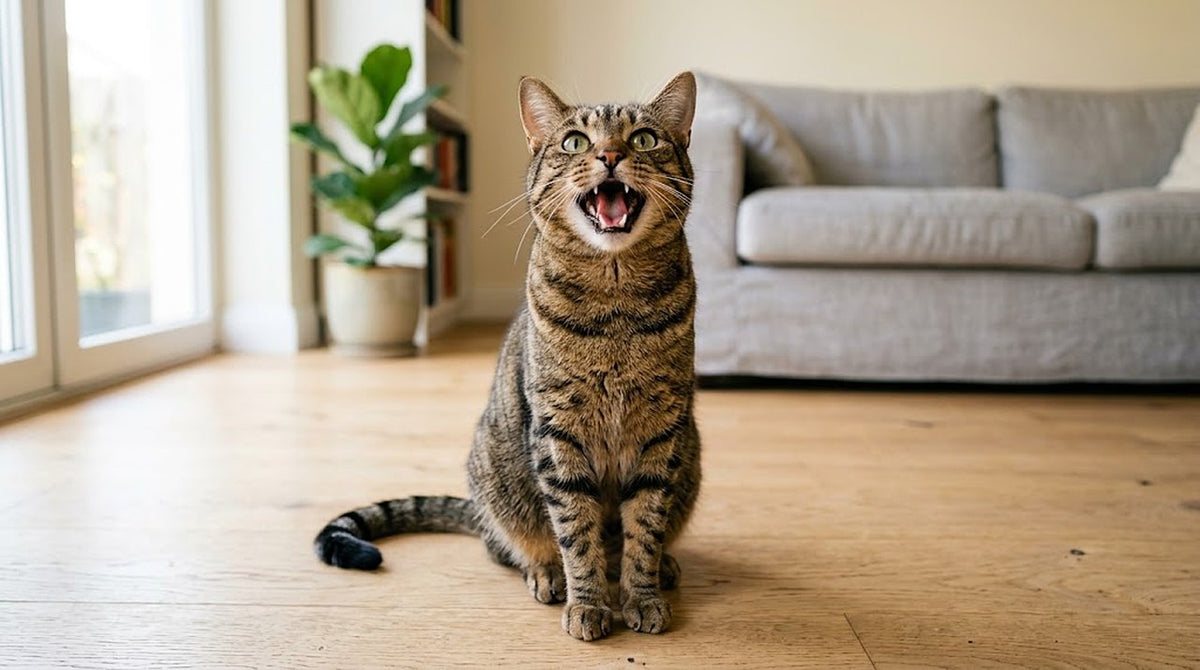
A meowing cat is talking to you. Adult cats almost never meow at each other: this sound is kept for humans, to say hello, to ask for something, or to tell you that something is wrong. The question is which of the three. Cat meowing at night, all the time, loudly and for no obvious reason, at the door, in the litter box, senior cat yowling: here are the causes case by case, what really works to calm your cat down, and the signs that should send you to the vet.
Cat meowing: the essentials in brief
| Who it is for | humans: adult cats hardly ever meow at each other |
|---|---|
| Common reasons | greeting, asking for attention, for food, for a door to be opened |
| First reflex | check its needs (water, litter box, closed door), then note when it meows |
| At night | an evening routine: play, dinner, cuddles; do not get up at every call |
| What not to do | scold, hit, feed “on demand” |
| See the vet | sudden change, senior cat that starts meowing, other symptoms, pain when touched |
| Emergency | straining or crying in the litter box without passing urine, especially a male |
| Female in heat | 4 to 10 days of calling, every 18 to 24 days, from February to September |
| Talkative breeds | Siamese, Bengal, Oriental, Tonkinese, Sphynx, Burmese |
Sources: ASPCA, International Cat Care, Cornell University, the SPA (France's animal protection society), Sevetys veterinarians. Details are at the end of the article.
Contents
Why is my cat meowing?
Because it is talking to you. Kittens meow to tell their mother they are cold or hungry; once grown up, cats stop meowing at each other but keep meowing at people all their lives, most likely because it makes people do what they want, as the ASPCA sums it up. The charity International Cat Care makes the same point: we respond to the meow, and that is what keeps it going.
Research points the same way. In 2004, a Cornell University researcher compared the meows of domestic cats with the calls of their closest wild relative, the African wild cat: our cats' meows are shorter and higher-pitched, and the people who listen to them find them far more pleasant. In 2009, a team at the University of Sussex showed that some cats slip a high-pitched cry into their purr when they are asking for food, and that we judge that purr more urgent than an ordinary one. In other words, your cat has a voice made for you.
The most common reasons
- To greet you: when you come home, when it meets you in the house, when you talk to it.
- To ask for attention: stroking, play, company. Cats left alone for long hours each day are more likely to.
- To ask for food: at mealtimes, whenever someone walks into the kitchen, or early in the morning.
- To be let in or out: it is its main way of telling you.
- To find a mate: a female in heat calls, an unneutered male answers.
- To say something is wrong: stress, pain, illness, or disorientation in an older cat.
Meow, purr, hiss: what does each sound mean?
Cats are said to have one of the widest vocal repertoires of all carnivores, reports International Cat Care, which sorts it into three families: “murmuring” sounds, made with the mouth closed; meows; and hostile sounds, made with the mouth open.
| Sound | How to recognize it | What it means |
|---|---|---|
| Purr | continuous, mouth closed | greeting, contentment; sometimes a request |
| Trill (chirrup) | short and rolled, mouth closed | friendly hello; mothers use it to call their kittens |
| Meow | varies widely in pitch, loudness and length | aimed at humans: greeting, request, protest |
| Chatter | jerky, with teeth chattering | excitement at the sight of prey, often a bird behind the window |
| Yowl | like a meow, but longer and drawn out | breeding season, stand-off between cats; long and low, it is a cry of distress |
| Growl, hiss, spit | mouth open | fear or anger: “keep away” |
Sources: International Cat Care, ASPCA, Sevetys veterinarians, the SPA.
High, low, long or short meow: what it means
A short, high-pitched meow is usually a greeting or a request. A long, plaintive one is more likely to express pain or discomfort, says Purina. A meow of displeasure is often hoarser or choppier, notes emergency veterinarian Aurel Hugounenq (Wanimo): a closed door, a litter box it does not find clean enough. A distress meow is long and low, sometimes mixed with hissing, with the ears flattened back, as the veterinarians at Sevetys, a French network of vet clinics, describe it.
The sound alone is not enough: also look at the moment, the place and the posture. A cat that meows with its tail up as it walks toward you is not saying the same thing as a cat that meows crouched down, with dilated pupils.
The cat breeds that meow the most
The Siamese and the Bengal are the best-known talkative cats; the Oriental, the Tonkinese, the Sphynx and the Burmese also like to “talk”, according to the Sevetys veterinarians. At the other end, the Persian, the British Shorthair and the Ragdoll are known for being quiet. These are tendencies: a Persian can be more talkative than a Siamese. And the Maine Coon trills more than it meows.
What you do matters too: owners who talk to their cat, especially in a high-pitched voice, find that it answers back, the same veterinarians note.
Cat meowing all the time: finding the cause
A cat that meows a lot does not necessarily have a problem: some are simply talkative. What matters is change. If it meows more than usual, louder, or at new times, look for what has changed, starting with its health.

My cat meows for no reason: really?
A cat never meows loudly “for no reason”, the SPA points out: the reason simply escapes us. To find it, the ASPCA suggests keeping a log for a few days: the time, the place, what happened just before, what made it stop. The pattern soon shows: always before meals, always at the same door, always when you are on the phone.
It meows for food
Do not feed your cat when it cries: you would teach it that meowing makes the bowl appear. Feed it at regular times, and wait until it is calm before serving. Cats are grazers that prefer 10 to 15 small meals a day, Aurel Hugounenq points out: if the daily ration comes in two meals, the cat begs the rest of the time.
- Split the ration into several small meals.
- Make it “hunt” its kibble with a treat-dispensing toy, like our fish kibble dispenser: it eats more slowly and keeps busy.
- If it wolfs everything down in a minute, a slow feeder bowl makes the meal last.
- For dawn wake-up calls, the ASPCA recommends a programmable automatic feeder: the cat ends up waiting by the feeder rather than by your bed. We do not sell one.
Is your cat on a diet and constantly asking for food? Talk to your vet, who will adjust the food. And if it is always hungry but losing weight, see the vet: it is one of the signs of hyperthyroidism.

It meows for your attention
The ASPCA's method comes down to one rule: your cat only gets your attention when it is quiet. Do not answer, and do not scold either (a telling-off is still an answer); wait for a moment of silence and immediately give it what it is after: stroking, a game. If it starts meowing again, walk away. With consistency, it catches on.
This rule only holds if its needs are met. If it spends its days alone, what it needs most is company and activity: play every day, things to do while you are out, or someone dropping in at midday.
It is bored
An apartment offers little stimulation, and a cat that cannot act on its hunting instinct ends up frustrated, explains Aurel Hugounenq: a cat that has properly “hunted” its toy meows less. It needs prey to chase, a scratcher and a lookout: cats love watching what is going on outside, the Sevetys veterinarians point out.

It meows at the door, to go out or come in
That is its way of asking. If you no longer want to be the doorman, the most practical solution is a cat flap, as both the SPA and the ASPCA advise. Ours has four settings: in the evening, you can set it so that your cat can come in but not go back out.
Did your cat use to go out, and you now keep it indoors? Expect a period of meowing at doors and windows: the change is hard for a cat and can take weeks, even months, the ASPCA warns. It does adjust, provided you never give in. A harness with a leash allows supervised outings, and a window hammock gives it a view of the outside.
At an inside door (the bedroom, the bathroom, the toilet), it is something else: a closed door between you and your cat annoys it, and it is asking for your company. See the bedroom door below.
It meows when I leave, or when I come home
When you come home, it is a hello: nothing to correct. If it meows as you leave, or if the neighbors hear it while you are out, it feels lonely. An apartment cat gets bored while you are away and makes up for it, loudly, when you come back, notes Aurel Hugounenq. Leave it things to do and keep some play time for the evening.
It has been meowing since a move or a change
A move, a new baby, a new pet, building work: your cat has lost its bearings and is telling you so. After a move, be there, speak softly and show it where its bowls, litter box, beds and scratchers are, the Sevetys veterinarians advise; the meowing fades as it finds its routines again. Sevetys and the SPA also recommend calming pheromones, as a diffuser or a spray.
If the stress sets in (eating much less or much more, licking itself constantly, soiling the house, hiding away), see the vet: these are the signs of a cat in distress, according to the SPA.
Female in heat, unneutered male
An unspayed female that starts meowing nonstop, rubs against you, rolls on the floor and asks for affection is probably in heat. It lasts 4 to 10 days and comes back every 18 to 24 days during the breeding season, roughly from February to September; an indoor cat may come into heat all year round, the ASPCA notes. An unneutered male that hears or smells a female will meow and pace for as long as she is in heat.
The only lasting solution is neutering, which the SPA considers preferable to hormonal treatments. It also limits escapes: during heat, males and females alike try to get out to find a mate, the Sevetys veterinarians note. If that happens, see our guide lost cat: what to do.
Cat meowing in the car
It is common: away from their territory, most cats are not happy travelers. Your cat may meow at first, or even for the whole journey; speak to it calmly, and never let it out of its carrier: the motion and noise of the car will eventually help it settle down or fall asleep, says International Cat Care.
- Leave the carrier open at home in the days before, so that your cat goes in and sleeps in it.
- Wedge it on the floor behind a front seat, or secure it with the seat belt; never in the trunk.
- Keep an eye on heat and ventilation.
- A pheromone spray on its blanket, 15 to 20 minutes before you put your cat in, can also help.
Our soft-sided carrier is ventilated on all sides and is held in place by the seat belt, passed through its handles.
Kitten meowing
A kitten meows to tell its mother it is cold or hungry. Newly adopted, it is expressing the stress of the change: for the first nights, you can set up a cozy nest in your bedroom, the SPA suggests, while it settles in. Do not expect quiet nights right away: a young cat is full of energy. Tire it out with play before bedtime.
Cat meowing at night: causes and solutions
Cats are not truly nocturnal: they are mostly active at dawn and dusk, when their prey comes out. Owners often describe two “mad quarters of an hour”, one very early in the morning, the other before nightfall, the Sevetys veterinarians note. Nothing forces your cat to wake you up, though: if it does, it expects something from you.

Why does my cat meow at night?
- It has learned that it works: you get up to check, so it does it again. This is often the case with a young, healthy cat.
- It is hungry, or it is anticipating its morning meal.
- It has not burned off enough energy during the day.
- It wants to go out: at nightfall, the hunting instinct wakes up.
- She is in heat, or he has detected a female.
- It is very young or old: the stress of adoption in a kitten, disorientation in a senior cat.
- It is in pain: a distress meow in the middle of the night calls for a prompt vet visit.
How do you calm a cat that meows at night?
The solution lies before bedtime. The SPA recommends an evening routine in three parts: play, food, cuddles.

- A real play session, the kind that makes it run and jump.
- A generous meal late in the evening, then a small ration of kibble to find during the night, in a dispenser or a puzzle toy.
- Stroking to help it settle.
- Its toys and a scratcher within reach all night.
Then hold firm. If your cat meows at bedtime when everything is fine, stop getting up: ignore its calls several evenings in a row. It will insist at first, then give up. In the meantime, the SPA suggests earplugs and, as a last resort, settling it at night in a room with its litter box, bed, water and food bowl.

It meows and scratches at the bedroom door
It is asking for your company. You can let it into the bedroom: that is one solution. Otherwise, discourage the scratching: a rubber mat with spikes or aluminum foil in front of the door, the SPA suggests. And do not open “just this once”: a door that opens now and then encourages it to insist.
It meows in the morning, very early
It is hungry, and it has figured out that waking you makes breakfast appear. Do not feed it as soon as you get up: separate the meal from your waking up. Two options, according to the Sevetys veterinarians: leave kibble available at all times so that it manages its own meals or, if your cat is overweight or on a diet, a feeder programmed for the time it gets hungry, even four in the morning.
Senior cat meowing: loudly, at night, for no reason
An older cat that starts yowling at night is not being difficult: have it examined. A cat is a senior from the age of 11, which is 60 in human years. Three things to have checked.
- Hyperthyroidism, the most common hormonal disease in senior cats according to the Sevetys veterinarians: the cat loses weight while eating more, drinks and urinates more, and is restless (Cornell Feline Health Center). Night-time vocalizing is relatively common in these cats, as it is in cats with high blood pressure, which can also leave them blind and confused.
- Cognitive dysfunction, whose signs resemble Alzheimer's disease. They become clearly noticeable from the age of 10: disorientation, disturbed sleep, staring blankly, house soiling, and episodes of loud vocalizing, often in the middle of the night, the same center describes.
- Pain and failing senses: arthritis, teeth, declining sight or hearing. A cat that is losing its sight loses its bearings and calls for you.
These problems are common: according to a review published in 2007 by researchers at the University of Edinburgh, 28% of cats aged 11 to 14 show at least one age-related behavior problem, and more than 50% from the age of 15. Many can be treated or eased: hyperthyroidism and high blood pressure are treatable, and your vet can help calm a disoriented cat. The ASPCA also lists kidney disease among the causes of excessive meowing in aging cats.
At home, make life easier: an easy-to-reach litter box with low sides, ramps if the stairs are a struggle, and no new pet that would stress your cat, the Cornell Feline Health Center advises.
When should you worry about a meowing cat?
A cat that meows a lot should be examined to rule out a medical cause, the ASPCA recommends: many diseases make cats hungry, thirsty or restless. See the vet without delay in these cases:
- it suddenly meows more, louder, or differently than usual;
- it is elderly and has started meowing, especially at night;
- it meows in the litter box, keeps going back to it or strains;
- it meows when touched or picked up;
- it eats or drinks more, or less, vomits, loses weight, hides;
- its voice has changed: hoarse, raspy, gone;
- a talkative cat has gone silent: that sudden silence often hides pain, the SPA warns.
It meows in the litter box, when peeing or pooping
Crying out while urinating is one of the signs of lower urinary tract disease, along with frequent trips to the litter box, blood in the urine and peeing outside the box, according to the Cornell Feline Health Center.
Emergency. A cat that strains in the litter box and passes only a few drops, or nothing, may have a blocked urethra. Males, neutered or not, are more at risk: their urethra is longer and narrower. It is an absolute emergency that can kill within a day or two: call your vet or an emergency clinic right away.
If it meows while passing stools, or strains without result, see the vet too. If it meows after using the litter box, without straining or crying, it may be telling you the box is no longer clean enough for its taste: a classic reason for protest, according to the SPA. And if your cat pees outside its box, see our guide to cat urine.
It meows when I touch it or pick it up
It probably hurts there: an injured paw, the back, the belly. It is a pain signal, especially if it is new, the Sevetys veterinarians note. Do not handle the area and have your cat examined.
Hoarse, raspy or silent meow
A meow that has turned hoarse can point to discomfort in the throat, Purina notes. The larynx, where the vocal folds are, is part of the upper respiratory tract: if your cat's voice changes or disappears, and even more so if it coughs, sneezes, or has a runny nose or eyes (the signs of a respiratory infection described by the Cornell Feline Health Center), take it to the vet.
A cat that has always meowed very softly, or almost without a sound, is not ill for all that: it is the change that matters.
What not to do
- Ignoring it without checking. It may have no water left, no access to its litter box, or be shut in a closet. You only let a cat meow when you are certain it is a demand, the ASPCA points out.
- Scolding or hitting it. Punishment sends it running at first, has no lasting effect on the meowing, and may teach it to fear you.
- Giving in every other time. Getting up “to make it stop”, opening the door, filling the bowl: each time, it learns that meowing for long enough pays off.
- Feeding it when it cries. Serve it when it is calm.
- Putting a sudden change down to personality. A cat that starts meowing differently has a reason, and it is sometimes medical.
Keeping a bored, meowing cat busy: our picks
A cat that has hunted, climbed and watched during the day meows less in the evening. Two kinds of toys complement each other:
- to play with your cat: the suction-cup bird toy, which you hold like a wand or fix to the floor, and the feather mice to throw;
- to keep it busy while you are out: the interactive feather and ball toy, which starts up again by itself a few hours later, the door yo-yo, the puzzle box and the fish kibble dispenser.
Add a scratcher and a lookout, such as a cat tree by a window. We do not sell programmable feeders or pheromone diffusers: for those two, see your pet store or your vet. The whole range: cat toys.
 Suction-cup bird toyView product
 Feather mice, set of 5View product
 Interactive feather and ball toyView product
 Automatic door yo-yoView product
 Felt puzzle boxView product
 Fish kibble dispenserView product
 Window hammockView product
 4-way cat flapView product
Frequently asked questions about cat meowing
Why is my cat meowing all the time?
Usually to get something: attention, food, an open door. If it meows more than usual or has only just started, have its health checked first.
Why does my cat meow at night?
Cats are active at dawn and dusk, and yours has learned that meowing gets you up. Hunger, boredom, wanting to go out, heat or, in an older cat, illness: the context tells you which.
How do you calm a cat that meows at night?
With an evening routine: play, a generous meal late in the evening, cuddles. Leave some kibble to find and its toys, then stop getting up at its calls several evenings in a row.
How do you make a cat stop meowing?
You do not silence it, you deal with the cause. Check its needs and its health, give it play and meals at regular times, then only give it attention when it is calm.
Should you ignore a meowing cat?
Only if you are certain it is demanding something and its needs are met. If in doubt, first check water, the litter box, a closed door, and its health.
Why is my cat meowing loudly for no reason?
There is always a reason, even if you cannot see it. Note for a few days when and where it meows. If it is new, see the vet: pain and several diseases make cats meow.
Do cats meow when they are in pain?
Often, yes: a long, plaintive meow, or a cry when the painful area is touched. But a talkative cat that suddenly goes silent may also be suffering.
Why is my old cat meowing at night?
Hyperthyroidism, high blood pressure, pain, failing sight or hearing, or cognitive dysfunction after the age of 10. Have it examined: many of these causes can be treated.
When should you worry about a meowing cat?
When it changes suddenly, when it meows in the litter box or when touched, when its voice turns hoarse, or if it eats, drinks or behaves differently.
Why does my cat meow in the litter box?
Crying out while urinating is a sign of urinary disease. If it strains without passing urine, especially a male, it is a veterinary emergency: its urethra may be blocked.
Why does my cat meow at the door?
It is asking to come in, go out or join you. A cat flap settles the outdoor question; for the bedroom, either let it in or never give in.
Why does my cat meow in the morning?
It wants its meal and knows that waking you makes it appear. Separate the meal from your waking up, or leave it to a programmable feeder.
How long does a cat in heat meow?
For 4 to 10 days, and it comes back every 18 to 24 days from about February to September, sometimes all year round indoors. Spaying puts an end to it.
Do cats meow at each other?
Hardly ever. Kittens meow for their mother; adults keep the meow for humans and communicate with each other through scent, posture and other calls.
Which cat breeds meow the most?
The Siamese and the Bengal, then the Oriental, the Tonkinese, the Sphynx and the Burmese. The Persian, the British Shorthair and the Ragdoll are known for being quieter.
Why is my kitten meowing at night?
It has just arrived and the change is stressful. Set up a nest near you for the first nights and tire it out with play before bedtime.
How do you calm a cat that meows in the car?
Get it used to its carrier at home, secure the carrier in the car, speak to it calmly and never let it out during the journey.
Can you punish a cat for meowing?
No. Punishment has no lasting effect on meowing and may teach your cat to fear you. Look for the cause and reward calm.
Sources
- ASPCA, “Meowing and Yowling” and behavior problems in older cats
- International Cat Care, cat communication and travelling with your cat
- Cornell Feline Health Center: cognitive dysfunction, hyperthyroidism, hypertension, lower urinary tract disease and respiratory infections
- The SPA, cat meowing at night: what to do (in French)
- Sevetys, cat meows explained (content approved by a veterinarian, in French)
- Wanimo, vet question: my cat meows a lot (Dr Aurel Hugounenq, in French)
- Purina, why is my cat meowing all the time (in French)
- Nicastro, Journal of Comparative Psychology, 2004: meows of domestic cats and African wild cats
- McComb et al., “The cry embedded within the purr”, Current Biology, 2009
- Gunn-Moore et al., Journal of Small Animal Practice, 2007: aging and cognitive dysfunction in cats
Article updated on October 4, 2026. This article is not a substitute for a consultation: if you have any doubt about your cat's health, call your vet. The photos in this article were generated by AI. Read also: lost cat, what to do, cat sleeping a lot and our Maine Coon guide.

