Cat-proofing a balcony: netting, fitting without drilling, copropriété and tilt-and-turn windows
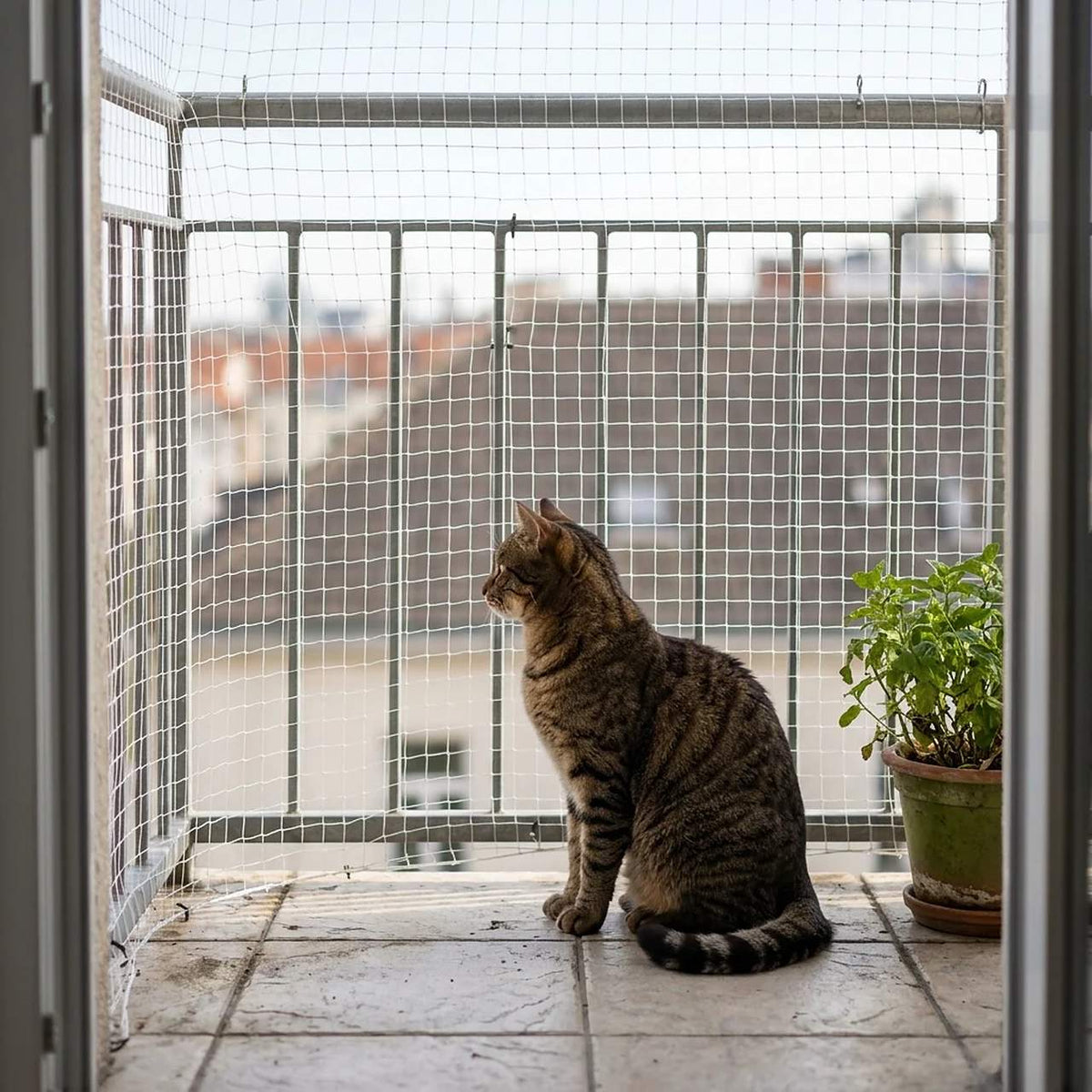
Cat-proofing a balcony means closing it off completely, from floor to ceiling and from wall to wall, with netting or wire mesh fine enough to stop the cat's head, on fixings that carry its weight. Everything else, reed screening, half-height plexiglass, a harness, a window left ajar, reduces the risk without removing it. That risk has been measured: in Berlin, in ten years, a single clinic took in 1,125 cats that had fallen from a building; 13% did not survive, and fewer than 4% were unhurt. Here are the figures on "high-rise syndrome", the trap of the tilt-and-turn window, the solutions compared, what really holds without drilling, the law in a copropriété (the French system of co-ownership of a block of flats) and for tenants, with court decisions to back it up, how to fit the netting, the plants to avoid, and what to do if your cat has fallen.
Cat-proofing a balcony: the essentials in brief
| The risk | in Berlin, 1,125 falls in ten years at a single clinic: 87% survival among the cats treated, 4% unhurt; 77% of the falls between April and September, 62% between 6 pm and 6 am |
|---|---|
| What really closes it off | netting or wire mesh from floor to ceiling, with no gap at the sides; a mesh of 3 cm or less; a steel wire in the netting if the cat chews |
| Without drilling | telescopic poles locked between floor and ceiling, a pressure-fitted or free-standing frame, battens tied to the railings; no suction cups, no adhesives on their own |
| The tilt-and-turn window | the cat gets trapped in it by its hindquarters: 10 to 35% die, depending on the study; never left tilted without a guard while you are out |
| In a copropriété | a vote at the assemblée générale (owners' general meeting) if the installation affects the common parts or the external appearance (loi du 10 juillet 1965, the French co-ownership Act, article 25 b); almost invisible nets allowed at Versailles in 2023, visible poles taken down at Pontoise in 2026 |
| Tenants | a minor alteration (aménagement) cannot be refused, a transformation requires the landlord's written consent (loi du 6 juillet 1989, the French residential tenancies Act, articles 6 and 7): ask for it |
| If your cat has fallen | the vet the same day, even if it is walking: serious breathing problems can appear within 48 hours |
Sources: Candela Andrade et al. (JFMS, 2025), Gradner et al. (2017), Graciolli Tomazi et al. (2024), the University of Veterinary Medicine in Vienna, International Cat Care, Cats Protection, FOUR PAWS; the French Acts of 1965 and 1989, the Cour d'appel de Versailles (Versailles Court of Appeal, 2023) and the Tribunal judiciaire de Pontoise (Pontoise court of first instance, 2026). The details are at the end of the article.
Contents
Cats falling from balconies: the risk, in figures
Vets speak of "high-rise syndrome" (in French, syndrome du chat parachutiste, literally "parachuting cat syndrome"): all the injuries of a cat that has fallen from a building. The largest study published, in 2025, covers 1,125 falls of at least 4 metres seen over ten years by a single clinic, that of the Free University of Berlin (Candela Andrade et al., Journal of Feline Medicine and Surgery). The clinic of the University of Veterinary Medicine in Vienna treats 70 to 80 a year. What these series measure:
- Survival. In Berlin, 86.7% of the cats survived; 13.3% died or were euthanised. Elsewhere: 83% in Israel (Merbl et al., 2013), 90% of the cats treated in New York (Whitney and Mehlhaff, 1987), 96.5% in Zagreb (Vnuk et al., 2004). Flattering figures: they count only the cats brought to the vet alive.
- Injuries. Only 3.7% of the Berlin cats were unharmed; a quarter (25.9%) had life-threatening injuries. Chest injured in 58% of cases, face in 51%, a broken leg in 47%, shock in 49%.
- Height. Average fall: 12 metres, the fourth floor; in Paris as in Berlin, cats fall mainly from the second to the fourth floor. No floor is safe: among the falls of less than 5 metres, first or second floor, 52% of the cats had moderate to life-threatening injuries, a fracture, a dislocation, a deep wound or a chest injury. And the higher the fall, the worse it is: survival stays above 80% up to 21 metres, then drops to around 60%. The idea that a cat comes off better from a great height comes from the New York study of 1987; neither Berlin nor Zagreb bears it out.
- Season and time of day. 77% of the falls between April and September, with a peak in July, and 62% between 6 pm and 6 am, when people come home and air the flat. In Israel, falls become rarer in the hottest part of the summer, when air conditioning keeps the windows shut: it is not the heat that makes cats fall, it is the open window.
- Age. Median age of 2.3 years in Berlin; 27% of the cats were under a year old (60% in Zagreb), 13% over eight, and adults are more seriously injured than young cats. Eight cats fell twice: a cat does not learn about the drop.
Why a cat falls
It does not throw itself into the void: a cat does not "deliberately" jump from a dangerous height, the ASPCA points out. It falls while chasing a bird or a butterfly, playing with another cat, fleeing a noise, or slipping off the ledge it was walking along, according to the Vienna veterinary university and International Cat Care. And the cat that "always lands on its feet" is a myth: from low down, it has no time to right itself and hits the ground on its side; from high up, it does right itself, but its legs cannot absorb the impact.
Tilt-and-turn windows and cats: the trap
When it is tilted open, the window leaves a V-shaped gap, wide at the top and closed at the bottom. The cat tries to get out at the top, slips into the V and gets stuck there, most often by its hindquarters; as it struggles, it slides further down. The compression cuts off the blood supply to the spinal cord, to the muscles and nerves of the hind legs, and sometimes to the kidneys.
Two studies put figures on it. In Vienna, 98 cats in twelve years: of the 71 with both hind legs affected, 35% died or were euthanised, two times out of three from sudden respiratory distress, often within hours of admission (Gradner et al., 2017). In Switzerland and Germany, of 70 cats that had been trapped for anything from a few minutes to twelve hours, 10% died (Graciolli Tomazi et al., 2024). The time spent trapped decides the prognosis: a cat's spinal cord tolerates only about half an hour of severely reduced blood flow.
The Vienna university's rule: never leave a cat alone with a tilted window that has no protection. Guards for tilt-and-turn windows, two side panels and a top piece, close off the V; the AniCura network of veterinary clinics finds that they often work very well. If you find your cat trapped, free it upwards, where the gap is wide, supporting its hindquarters, and set off for the vet even if it is walking again: fatal respiratory distress comes on after the cat has been freed.
How to cat-proof a balcony: the solutions compared
One criterion only: does the solution close the whole opening, and does it hold when the cat throws itself at it? Cats Protection recommends wire mesh or netting "from the ceiling to the floor"; the Vienna veterinary university, aviary wire mesh or wire-reinforced netting.

| Solution | For which balcony | Fitting | Seen from the street | Hold and limits |
|---|---|---|---|---|
| Netting from floor to ceiling | covered balcony, loggia, window | screw-in hooks, or a frame and poles with no drilling | almost invisible in black; the supports can be seen | closes everything; to be checked after strong winds |
| Rigid wire mesh on a frame | a cat that chews or climbs a lot | frame screwed on, pressure-fitted or free-standing | visible | stands up to teeth; heavier, more expensive |
| Plexiglass or polycarbonate | railings with bars | clamped onto the railings, with no drilling | almost invisible | does not close the top: a cat that jumps gets over |
| Reed screening, privacy screen | railings with bars | ties | very visible | they fill the gaps but do not stop a cat climbing onto the top rail |
| Enclosure or "catio" | terrace, top floor with no ceiling overhead | free-standing, with no drilling | visible | closed on every side; bulky, costly |
| Harness and lead | balcony not closed off, in the meantime | nothing to fit | invisible | only while you are there, never tethered alone |
| Window guard | casement or tilt-and-turn window | screwed or clipped to the frame | discreet | closes the gap; a window restrictor alone is not enough |
Cat-proofing a balcony without netting is possible, but not with just anything. Plexiglass fills in railings with bars and raises them: in the case decided at Versailles in 2023 (see the law), panels 80 cm high were mounted on the inside, with no drilling. But they "merely raise the height of the railings", writes the court: a cat that pushes off from a table gets over the top. The enclosure, or catio, is the only solution without netting that really closes the space off, and the right answer for cat-proofing a terrace or a top-floor balcony; otherwise, where there is no ceiling, the netting has to be given a roof.
Cat-proofing a window follows the same logic: a frame filled with wire mesh or netting, fixed in the window recess, lets you open the window wide. A window restrictor is not enough, a female cat treated by Blue Cross had slipped through a window "left open only very slightly"; nor is an insect screen: held on by light adhesive strips, it is easily damaged by the cat, notes the Vienna university.
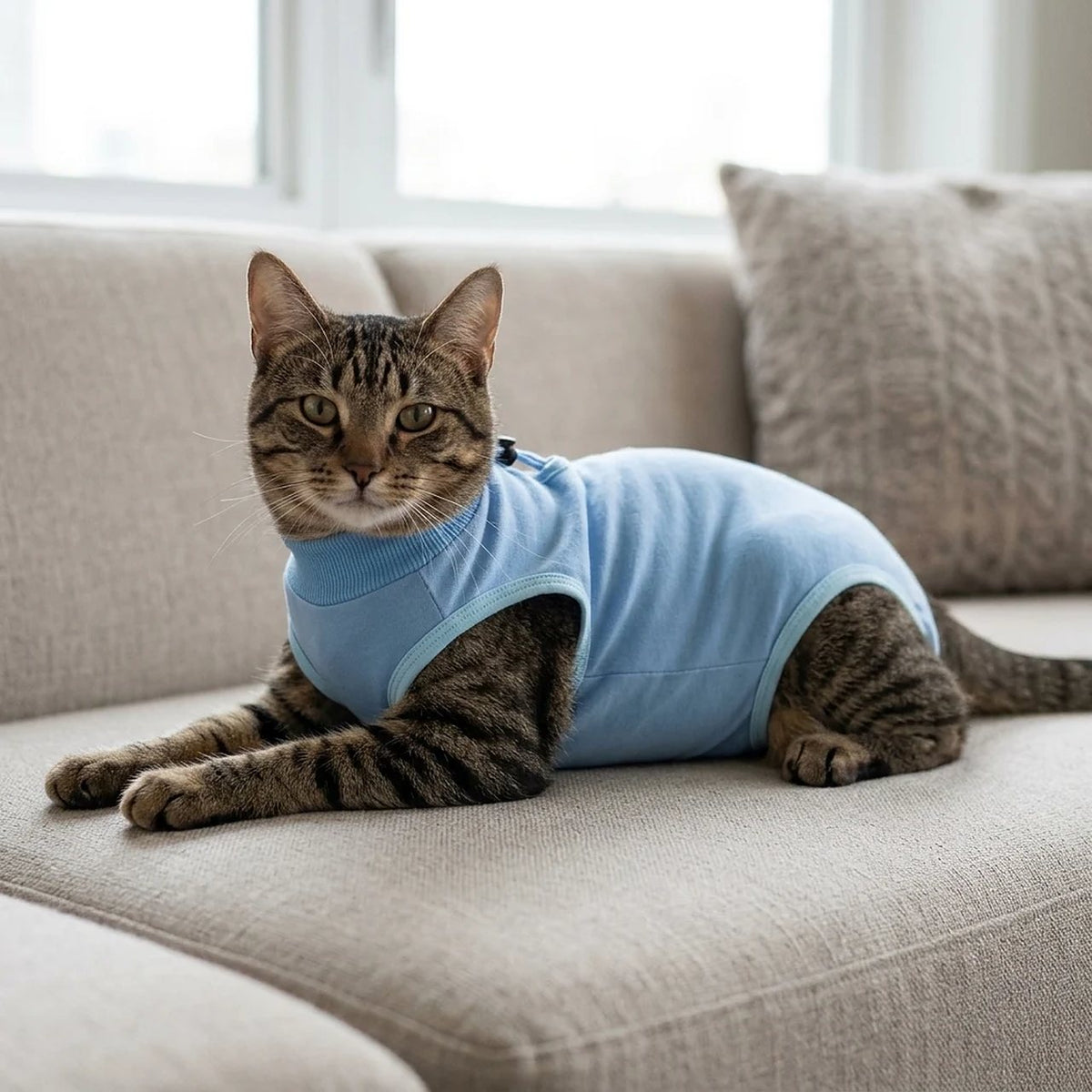
A harness does not make the balcony safe, it lets you be out there with your cat. RSPCA Australia accepts it only "under direct supervision" and opposes tethering. Lead in hand, then, with a wraparound vest, harder to back out of without being foolproof: our escape-proof harness with double fastening, in XS and S, or the vest harness with lead, from S to XL. The method for getting your cat used to it is in our guide to the cat harness.
Which cat netting to choose: mesh size, material, kittens, climbers and chewers
The mesh size. The criterion of the charity FOUR PAWS: small enough that the cat's head cannot fit through it. What is on sale goes from 19 mm at one French manufacturer to 3 × 3 cm at Trixie, and up to 5 cm, which Zooplus and Maxi Zoo consider enough for an elderly or heavily built cat. We found no measurement to support that threshold, and International Cat Care points out that cats, "particularly kittens", squeeze through very small spaces. Our advice: 3 cm or less, and for a kitten, check that its head does not fit through.
The material. Knotted nylon or polyethylene, UV-treated. A black net is less visible; a white one blends into a pale façade.
The cat that chews. FOUR PAWS and the Vienna university recommend netting with a built-in wire, or wire mesh. Let us be frank: our safety net for balconies and windows is knotted nylon, with no steel reinforcement, and a cat that chews at the mesh will wear through it in the end. For a confirmed chewer, choose reinforced netting, and replace any net as soon as a single mesh is damaged.
The cat that climbs. It will climb: the fixings must carry its weight at the top of the net, and the net must stay taut, with no gaps, so that the cat does not get tangled in it, a risk that Cats Protection points out.
The sizes. Ours comes in 3 × 4 m, for a window or a small balcony, and in 3 × 8 m, for a balcony that runs the length of the façade or a loggia, in white or black, to be cut to size with scissors; screw-in hooks, wall plugs and cord are supplied.

Cat-proofing a balcony without drilling: what really holds
A net is only as good as its weakest fixing, and that fixing has to hold a 4 kg cat, the median weight in the Berlin study, hurtling after a pigeon. Sorting them out, based on the set-ups described by the Vienna veterinary university:
| No-drill fixing | It holds if | Its limits |
|---|---|---|
| Telescopic poles between floor and ceiling | they are locked, on rubber feet, and the net is tied at top and bottom to a crossbar | you need a ceiling; at Pontoise, in 2026, vertical poles visible from the street had to be taken down |
| Full frame, pressure-fitted or free-standing | it is wedged into the recess, or heavy enough not to tip over | made to measure, more expensive; the best hold without holes |
| Battens tied to the railings | the railings are sturdy, and each upright is held by cable ties (zip ties) at two points at least | the top stays open without a crossbar or a roof |
| Adhesive hooks | a French manufacturer sells them, to be stuck on about every 20 cm, on PVC or render | everything depends on the glue, the surface and time: as a back-up to hold an edge flat, not to carry a cat that climbs |
| Magnets | the railings are made of iron | neodymium loses its strength outdoors, its seller warns |
| Suction cups | never for a net | they hold only on smooth glass and need checking every week: so say the instructions for our window hammock |
Two honest clarifications. Our net is fitted with hooks screwed into wall plugs: with drilling, then; without drilling, you need a frame or poles as well. And "without drilling" does not mean "without permission": what can be seen from the street is the uprights, not the net, and it is on them that the judges rule.
Cat netting on a balcony in a copropriété, or as a tenant: what French law says
We found no French legal text that mentions cat netting, either to require it or to forbid it. In Austria, protecting windows and balconies is a legal obligation, the Vienna university points out; in France, it is not.
You own a flat in a copropriété
The loi n° 65-557 du 10 juillet 1965 (the co-ownership Act) requires a vote of the assemblée générale, by a majority of the votes of all the co-owners, for "works affecting the common parts or the external appearance of the building" (article 25 b). Now the structural shell, and therefore the façade into which hooks are screwed, is deemed to be a common part (article 3), and many a règlement de copropriété (the building's co-ownership rules) protects the harmony of the building. The Act provides no exemption for "light" installations, whatever you may read: it is the judge who decides. The only two decisions we found on cat netting, both given in summary proceedings (en référé), show where the line falls.
- Cour d'appel de Versailles, 26 January 2023 (no. 22/03535). Nets on frames at the windows and plexiglass panels on the railings, fitted without a vote. The syndicat des copropriétaires (the body of co-owners), which was demanding their removal, lost: nets and plexiglass were "virtually imperceptible from the public highway", fixed without drilling into the railings, and twenty-five co-owners attested that they were not bothered by them.
- Tribunal judiciaire de Pontoise, 13 October 2026 (no. 25/01076). A net held by five vertical poles dressed in plastic foliage. The judge, who went to see the site: "the fitting of the vertical poles alone, and not of the net, which is barely visible, breaks the harmony of the façade". For want of a vote, the poles had to be removed within fifteen days, subject to a penalty payment (astreinte).
The lesson is a practical one. Read your règlement de copropriété, choose a fine net and fixings that cannot be seen from the street, photograph the façade before and after, and notify the syndic (managing agent) in writing. If the installation drills into the façade or can be seen, have the question put on the agenda of the assemblée générale, with a document specifying "the location and nature of the works" (décret du 17 mars 1967, the decree implementing the Act, article 10); if the majority is not reached but the proposal receives at least a third of the votes, a second vote is held immediately, by a majority of the votes cast (article 25-1).
You are a tenant
The loi n° 89-462 du 6 juillet 1989 (the residential tenancies Act) distinguishes two things. The landlord is required "not to oppose alterations (aménagements) carried out by the tenant, provided that they do not amount to a transformation of the rented property" (article 6, d); the tenant must not "transform the rented premises and equipment without the owner's written consent" (article 7, f). Service-public.fr, the French government's information site, gives a change of carpet as an example of an alteration the tenant is free to make, and ANIL, the national housing information agency, the putting up of shelves, which means drilled holes with wall plugs. A removable net looks much the same, but no legal text and no decision that we found says so: ask for the landlord's written consent.
In a copropriété, the règlement, extracts of which the landlord must give you (1989 Act, article 3), is binding on you too, and for anything that affects the façade, it is the landlord who takes the matter to the assemblée générale. Finally, no clause can forbid you to have a cat: any such clause is "deemed unwritten" for a pet that causes neither damage nor nuisance (loi du 9 juillet 1970, an Act of 9 July 1970, article 10).
Fitting a cat safety net, then looking after it
The screw-fixed method, the one our kit uses, in six steps.
- Measure the height and width of the opening, with a margin for the fixings.
- Unfold the net: it arrives folded into a diamond shape; pull gently on its four corners.
- Fit the hooks all the way round, walls, ceiling, floor or railings, screwed into their wall plugs: one about every 25 cm, the spacing one French manufacturer gives for its screw fixings.
- Thread the cord through the meshes along the edge, hook it on and pull it taut: no slack pocket, no space the cat could slip through, at the top or at the bottom.
- Trim the excess with scissors, right next to the knots.
- Test each edge by hand, and stay with your cat the first few times.
After that, check the tension and the fixings from time to time, and after every spell of strong wind; a net that is damaged or slack gets replaced. Even a perfect net does not spare you from keeping watch: Cats Protection recommends always supervising a cat on a balcony, and leaving it a way back indoors.
Toxic plants, shade, furniture: the balcony once it is closed off
Lilies first. Lilies and daylilies can kill a cat: "the entire lily plant is toxic: the stem, leaves, flowers, pollen, and even the water in a vase", writes the US Food and Drug Administration (FDA). A few grains of pollen licked off the coat can cause fatal kidney failure in less than three days, and after 18 hours without treatment the kidneys are generally lost. "Pollen-free" lilies are no safer, International Cat Care adds. At the slightest doubt, the vet straight away, or the CNITV, the French veterinary poison control centre, seven days a week from 8.30 am to midnight.
Other balcony plants. The ASPCA's list also classes as toxic to cats oleander, which can kill, lily of the valley, geranium, chrysanthemum, ivy, hydrangea, azalea, box, tulips, hyacinths and daffodils; and as safe, basil, thyme, rosemary, nasturtium and petunia.
The layout. Move any furniture that could serve as a springboard away from the edge, and provide shade and water. On the indoor side, a window hammock gives your cat a lookout post: its four suction cups go on a smooth, fixed pane, never on a window that opens onto a drop. A busy cat is less inclined to look for the weak spot: see our guide to the bored cat.

My cat has fallen from the balcony: what to do
- Find it. In shock, it hides as close by as it can: the owners quoted by Blue Cross found theirs outside, very quiet, or hiding under a motorbike cover. The method is in our guide lost cat: what to do.
- Transport it without handling it. The MSD Veterinary Manual advises wrapping it in a towel, putting it in a dark box with air holes, and moving its head, neck and spine as little as possible. Nothing to eat.
- Call the vet or the out-of-hours service as you leave.
- Go even if it is walking. "Even if there are no visible injuries", the cat must be examined, writes the Vienna university: stable at first, it can develop serious breathing problems within 48 hours and neurological signs up to 72 hours later. In New York, nine cats in ten had a chest injury, and the Berlin study notes that the clinical examination often does not reflect what the X-ray shows.
No delay at all if you see rapid or open-mouthed breathing, bleeding from the nose or mouth, a leg the cat will not put down, blood in the urine, or a cat lying prostrate. A cat that can be located is found faster: our collar with an AirTag holder (AirTag not included) has a safety buckle that opens if the cat gets caught.
Cat-proofed balcony and windows: our selection
The net to close things off, the harness for going out in the meantime, the hammock for looking outside, the collar for finding your cat again. The whole cat collection, and our cat harnesses and collars.
 Cat safety net, 3 × 4 m or 3 × 8 mView product
 Escape-proof harness with double fasteningView product
 Vest harness with lead, S to XLView product
 Suction-cup window hammockView product
 Collar with AirTag holderView product
Frequently asked questions about balconies, windows and cats
How do I cat-proof a balcony?
By closing it off completely: netting or wire mesh from floor to ceiling, with no gap at the sides, a mesh the cat's head cannot fit through (3 cm or less) and fixings that carry its weight. Reed screening, low plexiglass and a harness are no more than extras.
What is the best balcony protection for a cat?
Netting stretched from floor to ceiling: almost invisible in black, it closes the whole opening. For a cat that chews, netting reinforced with a steel wire, or wire mesh on a frame. On a balcony with no ceiling, a closed enclosure (catio) or netting with a roof.
How do I cat-proof a balcony without netting?
With a closed enclosure (catio) or rigid wire mesh on a frame. Plexiglass raises the railings but does not close the top; reed screening does not stop a cat climbing onto the top rail; a harness is only any use with the lead in your hand, never with the cat tethered alone.
How do I fit cat netting without drilling?
On telescopic poles locked between floor and ceiling, on a frame pressure-fitted in the recess or free-standing, or on battens tied to the railings with cable ties. No suction cups; adhesive hooks only as a back-up.
Is it forbidden to have a safety net on a balcony?
No, no law in France forbids it. In a copropriété (a co-owned block of flats), a vote of the assemblée générale, the owners' general meeting, is needed if the installation affects the common parts or the external appearance of the building (1965 Act, article 25 b).
Do I need the copropriété's consent for cat netting?
Yes, if the net or its supports can be seen from the street or are drilled into the façade. Nets that were "virtually imperceptible" were allowed without a vote at Versailles in 2023; five visible vertical poles had to be taken down at Pontoise in 2026.
As a tenant, can I put up cat netting on the balcony?
The landlord cannot oppose an alteration that does not transform the property (1989 Act, article 6), and a removable net looks like one. No legal text says so expressly: ask for the landlord's written consent.
What mesh size should I choose for cat netting?
A mesh the cat's head cannot fit through: 3 cm or less, and as small as possible for a kitten, which squeezes through very small spaces. The 5 cm sometimes advised for a heavily built cat rests on no measurement that we could find.
How do I stop a cat jumping off the balcony?
You cannot teach it not to: it does not jump on purpose, it falls while chasing a bird, when startled or when it slips. The only prevention is physical: close off the balcony, or only go out there with the cat in a harness, lead in hand.
Are tilt-and-turn windows dangerous for cats?
Yes: the cat gets trapped in the V-shaped gap, the compression cuts off the circulation to its hind legs, and 10 to 35% of cats die of it, depending on the study. Never leave the window tilted without a guard while you are out; a cat that has been trapped goes to the vet, even if it is walking again.
How do I cat-proof a window?
With a frame filled with wire mesh or netting, fixed in the window recess, which lets you open the window wide. A window restrictor is not enough, a slim cat gets through a narrow opening; nor is an insect screen held by adhesive strips, which the cat damages easily.
From what height can a cat fall without being hurt?
No height is safe. Of 1,125 falls studied in Berlin, half of the cats that fell less than 5 metres, first or second floor, were seriously injured, with a fracture, a dislocation or a chest injury, and only 4% of all the cats were unhurt.
What should I do if my cat has fallen from the balcony?
Find it, often hiding close by, wrap it in a towel, put it in a carrier without handling it and take it to the vet the same day, even if it is walking: serious breathing problems can appear within 48 hours.
How do I know if my cat is all right after a fall?
You cannot tell by eye: chest injuries, present in more than one cat in two, show up on an X-ray. Rapid or open-mouthed breathing, a nosebleed, limping, blood in the urine: an immediate emergency.
Which balcony plants are toxic to cats?
Lilies above all: the whole plant, pollen and vase water included, can destroy the kidneys in less than three days. Also oleander, lily of the valley, geranium, ivy, hydrangea and azalea. Safe: basil, thyme, rosemary, nasturtium, petunia.
Sources
- Candela Andrade et al., "High-rise syndrome in cats", JFMS, 2025, part 1 (epidemiology) and part 2 (injuries and survival): 1,125 falls in Berlin
- Whitney and Mehlhaff, JAVMA, 1987, Vnuk et al., JFMS, 2004 and Merbl et al., Israel Journal of Veterinary Medicine, 2013: New York, Zagreb, Israel
- Gradner et al., Vet Record Open, 2017 and Graciolli Tomazi et al., JFMS, 2024: cats trapped in a tilted window
- University of Veterinary Medicine, Vienna: 2015 press release and 2023 infographic (PDF, in German): causes, the 48 and 72-hour time frames, no-drill set-ups
- International Cat Care, "High-rise cats", 2025, Cats Protection, "Indoor cats", Blue Cross, 2017 and ASPCA, 2023
- FOUR PAWS, "Cat-proof Balcony", 2026, PDSA, 2024 and RSPCA Australia, policy A8: mesh size, catio, harness
- Loi n° 65-557 du 10 juillet 1965 (French co-ownership Act), articles 3, 25 and 25-1 and décret n° 67-223 du 17 mars 1967 (its implementing decree), article 10 (in French)
- Cour d'appel de Versailles (Versailles Court of Appeal), 26 January 2023, no. 22/03535 and Tribunal judiciaire de Pontoise (Pontoise court of first instance), 13 October 2026, no. 25/01076 (in French)
- Loi n° 89-462 du 6 juillet 1989 (French residential tenancies Act), articles 3, 6 and 7, loi n° 70-598 du 9 juillet 1970 (Act of 9 July 1970), article 10, Service-public.fr, works by the tenant, page verified on 28 May 2025 and ANIL (in French)
- FDA, "Lovely Lilies and Curious Cats", 2021, International Cat Care, "Lily poisoning in cats", 2025 and ASPCA, list of plants toxic to cats; CNITV (in French)
- MSD Veterinary Manual, "What to Do in a Dog or Cat Emergency", 2025, Urgences vétérinaires, "Mon chat est tombé du balcon" and AniCura, "Fenêtre oscillo-battante ou fenêtre à soufflet" (the last two in French)
Article updated 12 November 2026. The photos in this article were generated by AI. See also: the cat harness, the AirTag for cats, lost cat: what to do and the bored cat.