
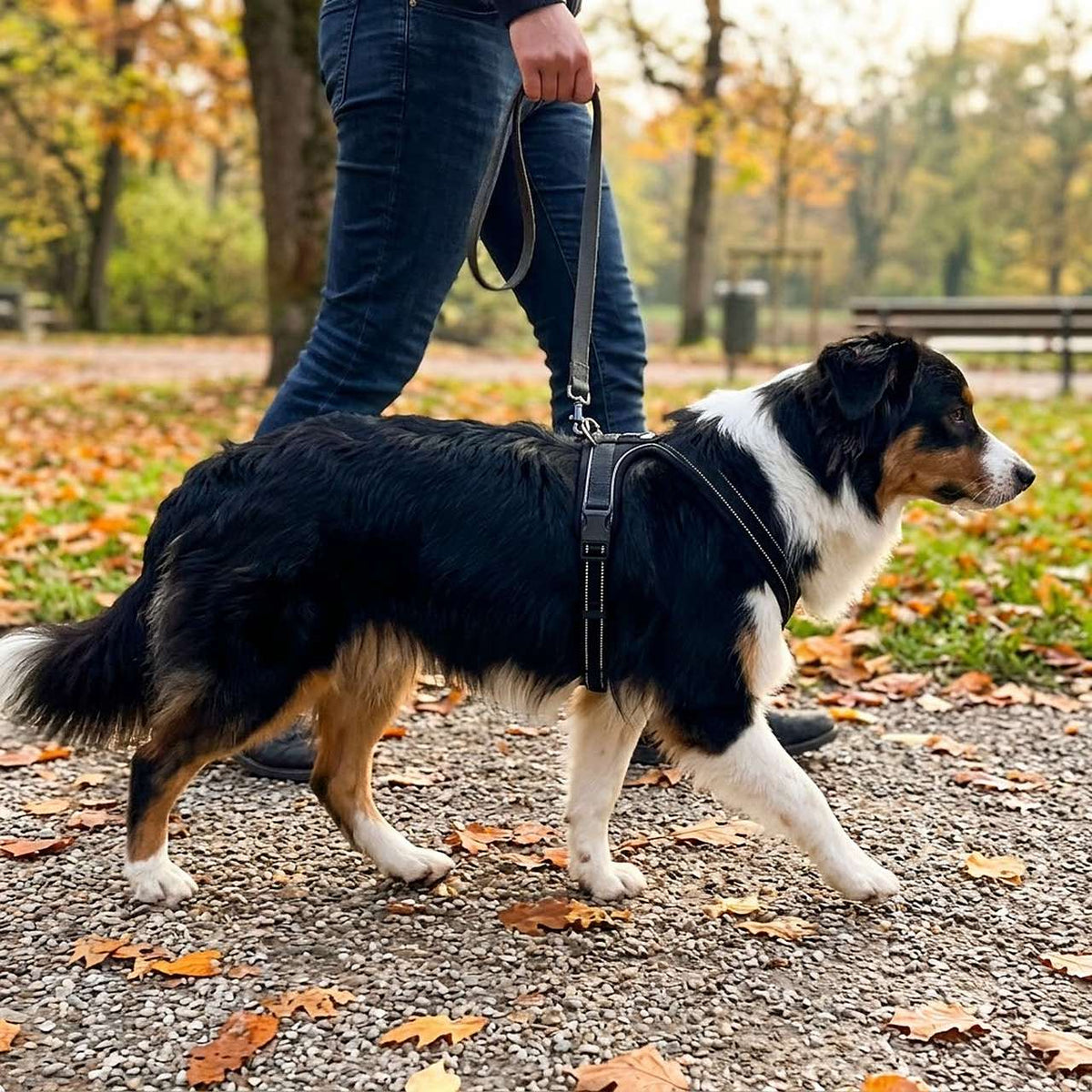
A dog harness is no longer just for dogs that pull: for many vets and trainers it has become the default walking equipment. The studies back them up on one precise point: a collar pulling on the neck raises the pressure inside the eye, a harness does not. But not all harnesses are equal, some restrict the shoulder, and none of them teaches a dog to walk on a leash. Collar or harness, vest, H, Y or no-pull, the two measurements to take, the two-finger test, how to put it on, and which harness for a puppy, a small dog, a bulldog or an older dog: here is what you need to choose without getting it wrong.
Dog harness: the essentials in brief
| Collar or harness | the harness for walking, especially a dog that pulls, a puppy, a small dog, a bulldog or a dog with fragile eyes; the collar for the ID tag, and for a calm dog that does not pull |
|---|---|
| Which one | a vest or an H-harness for everyday walks; a Y-harness, shoulders free, for sport; two rings, back and chest, for the dog that pulls; no model that tightens |
| If it pulls | the leash on the chest ring to limit pulling, but training solves the problem, not the equipment |
| The measurements | the chest girth just behind the front legs, at the widest point, and the neck girth at its base; weight is only a guide; between two sizes, the larger |
| A good fit | one to two fingers under each strap; the chest strap two or three fingers behind the elbows, not in the armpits; nothing on the throat |
| Putting it on | neck opening over the head, strap under the chest, two clips, adjust, leash; treats and short sessions for a puppy or a reluctant dog |
| Special cases | puppy: light and adjustable, rechecked every two weeks; senior dog: a handle, or a support harness; winter: a coat with a built-in harness |
Sources: studies by Pauli (2006), Carter (2020), Shih (2021), Lafuente (2019), Bailey (2025), review by Cavalli and Protopopova (2025), Santévet, PDSA. Details at the end of the article.
Contents
Collar or harness: what the studies say
This is not a matter of fashion, it has been measured. In 2006, an American veterinary team fitted 26 dogs in turn with a collar and a harness, measured the force they produced when pulling, then applied that same force while reading the eye pressure with a tonometer: intraocular pressure rose clearly with the collar, not with the harness. The authors concluded that dogs with fragile corneas or prone to glaucoma should wear a harness rather than a collar, especially during exercise (Pauli et al., 2006).
A British study from 2025 repeated the measurement on 24 dogs, short-muzzled and long-muzzled. In brachycephalic dogs (bulldogs, pugs, boxers…), simply wearing a collar at rest already raised the pressure in the eye; during exercise, the collar raised it in all dogs, and the harness in none (Bailey, Packer and Wills, 2025). On an instrumented neck model, seven collars and a slip lead exerted between 83 and 832 kPa on the "throat" when pulled the way a pulling dog pulls: no collar tested stayed below a pressure considered safe from injury (Carter, McNally and Roshier, 2020).
Should collars be thrown away, then? No. A 2025 review, which went through 21 studies on collars, harnesses and head collars, concludes that there is no universal device: a flat collar suits a dog that does not pull, because it restricts its movement the least; for the dog that pulls, a front-clip harness that does not tighten offers the best balance between effectiveness and comfort; for brachycephalic breeds, or when pulling is not an issue, a back-clip harness, Y-shaped or chest-strap, does the job (Cavalli and Protopopova, 2025). Another review, published in early 2026, points out that the evidence is still thin on many points, but that the neck houses the trachea, the thyroid, the vessels and the nerves that run up to the eyes: one more reason not to make it carry the pull (Ridgway, 2026).
Our reading: the collar keeps the tag, the harness takes the leash, as soon as the dog is likely to pull, is small, young, old, short-muzzled, or has had a problem with its trachea, neck or eyes. And for a dog perfectly trained to a loose leash, both are defensible.
Vest, H, Y, no-pull: the types of dog harness
Names vary from one shop to the next, but there are four main families, and one to avoid.
| Shape | Strengths | Weaknesses | For whom | |
|---|---|---|---|---|
| H-harness | two loops of strap, one at the neck and one around the chest, joined by a strip along the back | light, very adjustable, on in seconds, the most common | the chest strap can ride up into the armpits if badly adjusted; a supple dog that backs up can slip out | everyday walks, calm dogs |
| Vest harness (chest-strap, "Norwegian") | a horizontal strap around the chest and a band across the front, often padded | spreads the pull over the torso, easy to put on, often a handle on the back | the front band crosses in front of the shoulder: it limits its extension a little, especially if it sits low | walks, the dog that pulls moderately, small dogs |
| Y-harness | the front band runs from the neck down to the breastbone and splits into a Y between the front legs; the shoulders stay free | the recommended cut for sport, hiking, dogs that run a lot | more straps to adjust, more expensive; it must really be the right size for the Y to stay on the breastbone | canicross, dog hiking, sporty dogs or dogs with sensitive shoulders |
| No-pull harness (front clip) | any of the cuts above, with a leash ring on the chest in addition to the one on the back | when the dog pulls, the leash turns it towards you instead of carrying it forward; the most effective compromise according to the 2025 review | the leash can slip under the front legs; it takes a short leash and some work on training | the dog that pulls, while it learns to walk on a leash |
| Avoid: harnesses that tighten | "no pull" models whose straps tighten under the armpits or around the torso when the dog pulls | they work through discomfort | rubbing, pain, a dog wary of its walk; discouraged by the 2025 review, like choke collars | nobody |
One detail matters more than the label: where the front strap sits. On a treadmill, nine dogs filmed walking and trotting lost a few degrees of shoulder extension with both harness types tested, and, surprisingly, a little more with the so-called "non-restrictive" Y model than with the chest-strap one (Lafuente, Provis and Schmalz, 2019). In other words, the cut is not everything: the fit decides whether the shoulder is restricted. We come back to it below.
My dog pulls on the leash: which harness, and what else?
First the bad news: a harness does not teach heelwork. On 52 shelter dogs lured by a treat, the pull measured on the leash was stronger and more sustained with a back-clip harness than with a collar, with no more signs of stress; when the lure was a toy, no difference (Shih, Phillips and Mills, 2021). It makes sense: a harness spreads the force, so pulling does not hurt, so the dog pulls. That is exactly what we want for its neck, and that is why it must be taught something else alongside.
The good news: the front ring reduces pulling. In a 2024 study on 23 dogs, a front-connection harness reduced the pulling impulse compared with a flat collar as much as prong collars did, without their principle (Johnson and Wynne, 2024). Mechanically, when the dog lunges forward, the leash clipped to the chest turns it towards you: it loses its footing, and its momentum with it. It is not painful, it is disconcerting, and it leaves time to reward the next step, the one where the leash is slack.
What works, in practice:
- Two rings: the leash on the chest during training and in tricky spots, on the back when it walks nicely. Our adjustable and AirTag harnesses have both.
- A short leash in town, 1.5 to 2 m: the longer the leash, the more momentum it gets. No retractable leash for training: the constant tension of a retractable teaches exactly the opposite.
- The lamp-post rule: tight leash, you stop; slack leash, you move on. A few days of slower walks, and plenty of treats when it comes back to your side.
- A long line in the park, 5 to 10 m on the harness, never on a collar: it sniffs and burns off energy, and arrives in town already calmer.
- For big dogs that take off like a shot, a bungee leash absorbs the jolts for you. If nothing changes in a few weeks, a reward-based trainer sorts it out in a few sessions. The full method, step by step, is in our dog pulling on the lead guide.

Is the harness "dangerous"? You will read on some trainers' blogs that a front-clip harness "throws the dog off axis" and damages its shoulders. The 2025 review found nothing of the kind in the published studies, provided the harness does not tighten and the front strap does not cross the shoulder. The real, documented risk is the collar on a dog that pulls.
What size of harness: the two measurements to take
The weight printed on the packaging is a guide, not a size: a cocker spaniel and a whippet of 12 kg have neither the same chest girth nor the same neck. Get the tailor's tape, dog standing, relaxed:
- The chest girth, at the widest point, just behind the front legs, the tape flat on the coat. This is the measurement that counts.
- The neck girth, at the base of the neck, where a collar would sit, not under the throat.
- For a Y-harness or a model that closes on the back, some brands also ask for the length of the breastbone or the neck-to-chest distance: follow their guide.

Then compare with the size guide of the model you have chosen, not with a generic chart. Between two sizes, take the larger one: straps tighten, they do not stretch, and a dog gains a little chest girth with its winter coat. If your dog is at the bottom end of a size on both measurements, still take that size and not the one below: a harness that is too short along the back rides up into the armpits.
To give you an idea, here are the ranges of our own models, measured on the harnesses:
| Model | Sizes | Chest girth | Neck girth | Indicative weight |
|---|---|---|---|---|
| Vest harness for small dogs | XXXS to L | 24 to 54 cm | 20 to 42 cm | 0.5 to 10 kg |
| Adjustable reflective harness, two rings | S to XL | 49 to 101 cm | 28 to 81 cm | 4 to 50 kg |
| Harness with AirTag holder | M to XL | 46 to 93 cm | 44 to 79 cm | about 8 to 35 kg |
| Tactical harness with handle | S to XL | 45 to 94 cm | 37 to 75 cm | 7 to 40 kg |
| Coat with built-in harness | S to 4XL | 34 to 68 cm | 24 to 47 cm | small to large dogs |
You can see the problem with charts by breed: a 12 kg dog fits three of our sizes depending on its build. Measure.
A good fit: the two-finger test
A well-chosen but badly adjusted harness does worse than a well-worn collar. The landmarks, the same at the British veterinary charities and in the 2025 review:
- One to two fingers, flat, slide under each strap. No more: it slips out by backing up. No less: it rubs.
- The chest strap sits two to three fingers behind the elbows, not in the hollow of the armpit. This is the most common mistake, and the one that irritates the skin and restricts the shoulder.
- The neck opening rests at the base of the neck, on the shoulders, never on the throat. On a Y-harness, the point of the Y falls on the breastbone, the bone you feel between the front legs.
- The rings are centred: the back one between the shoulder blades, the chest one in the middle of the chest. A harness that turns to one side is too big or badly adjusted.
- The walking test: let it trot, sit, lie down. The front legs must swing freely forward; if it shortens its stride or paddles, loosen the chest strap or move it down a notch.
Recheck the fit every two weeks on a puppy, at every change of season on an adult (winter coat, weight), and every time you find broken hairs or pink skin under a strap. A harness also gets washed: by hand or in a laundry bag at 30 °C, dried flat, because a strap crusted with dried mud chafes.
How to put a harness on your dog
Most harnesses, including ours, go on over the head and close under the chest:
- Open the clips and loosen all the straps the first time.
- Pass the neck opening over the head, label or handle upwards, the back ring between the shoulder blades.
- Bring the chest strap under the belly, just behind the front legs, and close the clip or clips on the side.
- Adjust: two fingers under each strap, the chest strap behind the elbows.
- Clip the leash to the back ring, or to the chest ring if it pulls. Check that the clip is properly closed.
Step-in harnesses, on the other hand, are laid flat on the floor: the dog puts a paw in each loop, you lift the harness and clip it on the back. Handy for a dog that does not like having something passed over its head.
If it backs away, freezes or bites the harness, you are going too fast for it. Show it the harness, treat. Lay it on its back without fastening, treat. Pass the neck opening and take it straight off, treat. Then close one clip, then two, and go out straight away to do something pleasant: the harness becomes the signal for the walk. Two or three days of five-minute sessions are almost always enough. A puppy can wear a harness from its very first outings, around 2 or 3 months, as long as it is light; it is even the best time to get it used to one.
Which harness for your dog

The puppy. Light, mesh, very adjustable, with a single clip so that dressing is quick. It grows from size to size: do not buy too big "to last", a loose harness comes off by backing up. Recheck the fit every two weeks and change size without waiting. A puppy does not need a front ring at first: the bad habits have not been formed.
The small dog, 1 to 10 kg. A breathable mesh vest, with no hard edge, that spreads the pull over a narrow chest. Small breeds have a fragile trachea and are often carried: a handle is less useful than a light leash. Our vest harness for small dogs goes down to XXXS, from 24 cm of chest girth, and fits cats too.
The bulldog, the pug, the boxer. Never a leash on the collar, the eye-pressure measurements leave no doubt. A back-clip harness, vest or Y, wide and breathable because these dogs overheat quickly; and walks at the cool hours.
The big, powerful dog. Wide straps, locking buckles, metal rings, and a handle on the back to hold it back at the crossing or help it into the boot. Our tactical harness is cut for that; the adjustable two-ring harness adds the front ring for pulling.
The athlete and the hiker. A Y-harness that frees the shoulders, a back ring set well back, and to run with it a bungee leash on a waist belt rather than in the hand. Careful: a canicross pulling harness is the opposite of a no-pull, it is made for the dog to pull.
The senior or arthritic dog. A harness with a back handle helps it on the stairs; when the hindquarters give way, a rear support harness with handles, passed under the belly, lets you carry part of its weight without lifting it. Choose models that go on without lifting the legs. Weight, exercise, treatments and the home: our guide dog arthritis.
The dog that runs off or gets lost. A harness with an AirTag holder keeps the tag safe from knocks and rain: if it bolts after a deer, you find it on your phone. Think also of the tag on the collar and an up-to-date microchip.
Winter. Rather than piling a coat on top of a harness, a coat with a built-in harness (our guide dog coat says which dogs need one), fleece-lined, with the leash ring on the back. And reflective trim, whatever the model, because we walk in the dark five months a year.
In the car. A dog must be restrained or behind a guard: it is a safety matter for everyone, and most insurers require it. A seat-belt tether clipped to the harness, never to the collar, does the job for everyday trips; a walking harness is not crash-tested, and for long journeys a travel crate protects better.

And the leash?
A good harness with the wrong leash makes for a bad walk. In town, 1.5 to 2 m: it stays by your side, you bring it back with one movement at the crossing. In the park or on a trail, 3 m, it sniffs without pulling. For recall, a long line of 5 to 10 m, always on the harness: a sudden stop at the end of 10 m on a collar is a whiplash to the neck. The retractable leash has its place on an open path with a dog that does not pull, not in town or during training. And if your dog weighs 30 kg and takes off like a sprinter, a bungee leash spares your shoulder as much as its back.
Dog harnesses: our selection
All our harnesses go on over the head, close with clips and carry reflective trim. The measurements for each size are on the product pages; between two sizes, take the larger one.
 Adjustable harness, two rings, S to XLView product
 Vest harness and leash for small dogs, XXXS to LView product
 Harness with AirTag holder and leash, M to XLView product
 Tactical harness with handle, S to XLView product
 Coat with built-in harness, S to 4XLView product
 Rear support harness for senior dogsView product
 Bungee leash with seat-belt tetherView product
 Training long line, 1.2 to 30 mView product
Frequently asked questions about dog harnesses
Collar or harness for walking a dog?
The harness to hold the leash, the collar for the tag. A collar that pulls raises the pressure in the eye and compresses the trachea; a harness spreads the force over the chest. A calm dog that never pulls can stay on a collar.
Which harness for a dog that pulls on the leash?
A two-ring harness that does not tighten: the leash on the chest ring turns it towards you when it pulls. It is the most effective compromise measured, but loose-leash training is what solves the problem.
H-harness or Y-harness: what is the difference?
The H has a loop at the neck and one around the chest, joined on the back: simple and adjustable, for walks. The Y runs from the neck to the breastbone and frees the shoulders: for sport and dogs that run a lot.
Is a no-pull harness dangerous for the dog?
Not according to the published studies, as long as it does not tighten and the front strap does not cross the shoulder. Those that tighten under the armpits when the dog pulls are the ones to avoid.
How do I measure my dog for a harness?
Dog standing, tailor's tape: the chest girth just behind the front legs, at the widest point, and the neck girth at its base. Compare with the model's guide; between two sizes, take the larger one.
What size of harness for a 10 kg dog?
It depends on its build: a 10 kg dog can have a 40 cm chest if it is slim, 55 if it is stocky. Weight is only a guide: measure the chest and the neck.
How do I know if the harness fits properly?
One to two fingers slide under each strap, the chest strap sits two or three fingers behind the elbows, nothing presses on the throat, and it trots without shortening its stride. If it slips out by backing up, tighten or change size.
How do I put a harness on a dog?
Neck opening over the head, back ring between the shoulder blades, strap brought under the chest behind the front legs, clips closed, two-finger adjustment, then the leash. With treats the first few times.
At what age can a puppy wear a harness?
From its very first outings, around 2 or 3 months, with a light and very adjustable model. It is the best age to get used to it. Recheck the size every two weeks: it grows fast.
Which harness for a small dog or a chihuahua?
A soft mesh vest, with no hard edge, that spreads the pull over a narrow chest and spares a fragile trachea. Our sizes go down to 24 cm of chest girth.
Which harness for a bulldog or a pug?
A back-clip harness, vest or Y, wide and breathable. Never a leash on the collar: in short-muzzled dogs, the collar raises the pressure in the eye even at rest.
Which harness for a senior or arthritic dog?
A harness with a back handle to help it on the stairs and into the car, that goes on without lifting the legs. If the hindquarters weaken, a support harness with handles carries part of its weight.
Can the harness stay on all day?
Better to take it off at home: it can catch on things, hold moisture and irritate the skin under the straps. The collar with the tag, on the other hand, stays on.
Where do I clip the leash: on the back or on the chest?
On the back for a quiet walk and for a puppy. On the chest when it pulls, during training, or in tricky spots. Both at once, with a double-ended leash, for a very large dog.
Does a harness make a dog pull more?
With a back ring, yes, a little: pulling does not hurt, so it pulls. That has been measured. It does not mean going back to the collar, but teaching a loose leash, and using the front ring in the meantime.
How do I wash a dog harness?
By hand in warm soapy water, or in the machine in a laundry bag at 30 °C, then dried flat, away from the radiator. A strap crusted with dried mud chafes the skin.
Can I restrain my dog in the car with its harness?
Yes for everyday trips, with a seat-belt tether clipped to the harness, never to the collar. A walking harness is not crash-tested: for the road, a travel crate protects better.
Sources
- Pauli, Bentley, Diehl and Miller, "Effects of the application of neck pressure by a collar or harness on intraocular pressure in dogs", Journal of the American Animal Hospital Association, 2006
- Bailey, Packer and Wills, "Effect of a collar and harness on intraocular pressure and respiration rate of brachycephalic and dolichocephalic dogs", Veterinary Medicine and Science, 2025
- Carter, McNally and Roshier, "Canine collars: an investigation of collar type and the forces applied to a simulated neck model", Veterinary Record, 2020
- Cavalli and Protopopova, "Review of collars, harnesses, and head collars for walking dogs", Animals, 2025
- Ridgway, "Health implications of dog-worn equipment: a review of known and alleged physical risks", Frontiers in Veterinary Science, 2026
- Lafuente, Provis and Schmalz, "Effects of restrictive and non-restrictive harnesses on shoulder extension in dogs at walk and trot", Veterinary Record, 2019
- Shih, Phillips and Mills, "Dog pulling on the leash: effects of restraint by a neck collar vs. a chest harness", Frontiers in Veterinary Science, 2021
- Johnson and Wynne, "Comparing efficacy in reducing pulling and welfare impacts of four types of leash walking equipment", PeerJ, 2024
- Santévet, "Quel est le meilleur harnais pour son chien ?", updated September 2026 (in French)
Article updated on 15 October 2026. The photos in this article were generated by AI. Read also: dog ticks: removing and preventing them, cat harness and Christmas with a dog or a cat: the dangers.

