
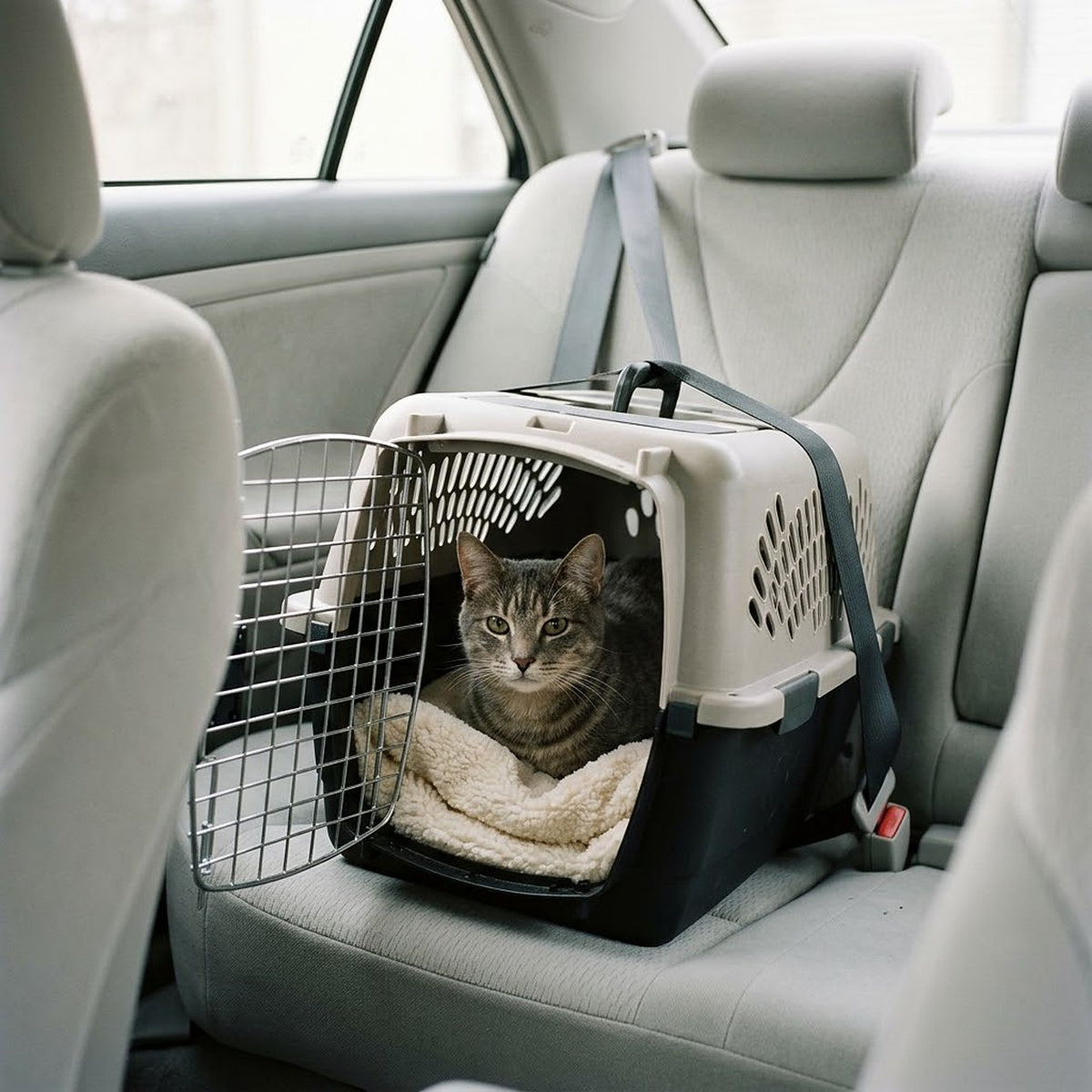
A cat in the car does not work like a dog in the car. A cat is not strapped onto the back seat with a harness, it does not put its head out of the window, and it does not "get used to it" by itself through repeated trips: it travels in a carrier, always, and everything else follows from that. Which one to choose, where to put it and how to belt it in, how to get your cat used to it over a few weeks so that it stops howling, what the studies really say about pheromones and sedatives, how to handle a long journey with litter and water, heat, and what French law says. Whether it is for the vet, the holidays or moving house.
Cats in cars: the essentials in brief
| Never loose | a loose cat in the cabin ends up under the pedals, on the dashboard or outside at the first open door; the law also punishes anything that hinders the driver |
|---|---|
| The carrier | rigid, plastic, with a sturdy wire door and a top that opens; big enough to turn around, no more; one carrier per cat |
| Where | on the floor behind a front seat, or on the back seat, belted through the handle; never in the boot, never in the front |
| Getting used to it | the carrier open in the living room weeks ahead, with its bedding and treats; then the door closed, then the parked car, then around the block |
| Calming it | a towel over the carrier, smooth driving, no loud music; pheromones sprayed 15 minutes before; for very anxious cats, an anxiolytic prescribed by the vet |
| Long journeys | no meal 4 to 5 hours before, water offered at stops, a travel litter tray in the closed car; never an open carrier with a door open |
| Heat | never alone in the car: the cabin gains almost 2 °C every 5 minutes |
Sources: International Cat Care, Shu and Gu 2022 (pheromones and transport, randomised trial), Pratsch et al. 2018 (carrier training), Légifrance (R412-6), McLaren et al. 2005 (heat). Details at the end of the article.
Contents
Taking a cat in the car: which carrier, and why not without one
The question "can you transport a cat in the car without a carrier?" comes up constantly, and the feline charities' answer is no, for three reasons. First the driver's safety: a panicked cat dives under the pedals, onto the steering wheel or against the windscreen. Then its own: at the first hard braking it is thrown, and at the first open door, at a service area, it vanishes; a cat lost far from home does not come back. Finally the law: article R412-6 of the French Highway Code requires the driver to keep their movement and field of vision free of any passenger or transported object, on pain of a second-class fine (35 €). It imposes no carrier, but a cat on the parcel shelf or on your lap breaks it.
And the harness? It is for holding a cat when you open the carrier, not for transporting it: a cat tethered on a back seat wriggles, gets stuck, and a supple cat backs out of a harness. Our cat harness guide explains when it is useful.
The right carrier, according to International Cat Care:
- Rigid and sturdy, in plastic, with a wire door that locks and ventilation slots on the sides; cardboard tears, wicker baskets and light fabric bags are hard to clean and a determined cat gets out.
- Top-opening, or with a removable upper half: you lower the cat in from above, and the vet can examine it without dragging it out.
- Its size: it must be able to stand, turn around and lie down, no more. "Larger is not necessarily better", the charity insists: a cat likes small spaces, and in a big carrier it gets thrown about.
- One carrier per cat, even for two cats that get on: the stress of the journey is enough to start a fight.
- For everyday trips, a rigid or semi-rigid carrier bag with a window and vents does the same job, provided it really closes and holds its shape; bubble-window backpacks suit curious cats, "paws-out" front slings are made for walking, not for driving.
Inside: an absorbent layer (pad or towel) under its usual bedding, which smells of home, and nothing that rolls. No full water bowl: it tips over at the first bend; water is offered at stops.
Where to put the carrier in the car, and how to secure it

- On the floor, behind the front passenger seat: this is the spot International Cat Care recommends for a medium carrier. Wedged between the back seat and the seat back, it does not move under braking, it is in the shade and cool, and the cat sees less of the scenery rushing past, which soothes most of them.
- On the back seat, belted: the seat belt goes through the handle or around the carrier and buckles; the carrier rests flat on a folded towel to stay level. Check it does not slide when you push it. This is the place for large carriers and cats that prefer to see.
- Never in the boot of a saloon: no air, no eye on it, and heat that rises fast; in an estate, the rear load area is still inadvisable for the same reasons of ventilation and sun on the rear window.
- Never in the front: the passenger airbag, designed for a belted adult, would crush the carrier as it deploys.
- A towel over the carrier, leaving the front ventilated: darkness reassures a stressed cat, and it does not have trees rushing past its eyes.
- The carrier is closed before leaving the house, and reopened after getting back inside; on the road, it never opens with a door open.
Getting your cat used to the carrier and the car: the method that works
The cat that howls from the first kilometre to the last is almost always a cat that only sees its carrier twice a year, fetched from the garage an hour before the vet. An Austrian study from 2018 trained cats to their carrier over several weeks, then measured their stress during a car trip and a consultation: the trained cats showed fewer signs of stress in the car and let themselves be examined faster than the others (Pratsch et al., Applied Animal Behaviour Science, 2018). The method, as International Cat Care and this study describe it:
- The carrier is part of the furniture. Door open or removed, in the room where it lives, with its bedding inside, for several weeks. Treats "appear" in it regularly. It is never pushed in.
- It eats in it, it sleeps in it. Once it goes in by itself, serve a few meals in it, play with a wand toy that ends up inside the carrier.
- The door closes, for a few seconds, treat, it reopens. Then one minute, then five, then you lift the carrier and set it down. At each step, if it growls or scratches the door, go back one step the next day.
- The parked car, engine off, the carrier in its place, two minutes, and back home with a treat. Then engine on. Then around the block, then ten minutes. The idea: most trips lead nowhere unpleasant.

Allow three to six weeks for a wary adult cat, far less for a kitten, which you train from adoption. And once learned, keep it up: the carrier stays out, and one trip in three does not go to the vet.
A cat that meows in the car: calming it, pheromones, sedatives
A cat that meows in the car is frightened, it is not "being difficult". A few meows at the start are normal; continuous howling, panting, drooling or urine in the carrier say the trip is too much for it. In order:
- The setting: carrier wedged, in the shade, covered with a towel, cool cabin (no heating blasting onto the carrier, no air-con on it), radio low or off, smooth driving without jolts. Talk to it in a calm voice; do not take it out to "reassure" it, the opposite happens.
- Synthetic feline facial pheromones, sprayed on the carrier bedding 15 to 20 minutes before putting the cat in (the spray smells of alcohol at first, International Cat Care notes). A randomised double-blind trial on 150 cats stressed by transport showed a reduction in stress behaviours, curling up, immobility, meowing, in treated cats compared with placebo, the effect being clear in the most stressed cats (Shu and Gu, Journal of Feline Medicine and Surgery, 2022). It is not magic, it helps.
- "Calming" supplements (alpha-casozepine, L-theanine, valerian) have thinner evidence; they do no harm, started a few days before.
- For a cat that panics, the vet can prescribe an anxiolytic to give one to two hours before departure; gabapentin is the most studied molecule in cats for trips and consultations. Never human sleeping pills, never self-medication: several common drugs are toxic to cats.
- Car sickness exists in cats too: drooling, yawning, vomiting. The same measures ease it, and the vet has an anti-emetic if needed.
Long car journeys with a cat: water, litter, breaks
Before. No meal in the four to five hours beforehand, International Cat Care recommends, to limit nausea; water until departure. Claws trimmed, the tag on the collar (a safety-buckle collar), microchip up to date, and the health record in the bag. For a house move or holidays, pack in the car: a folding travel litter tray and a bag of litter, water and a bowl, spare absorbent pads, a bag for soiled ones, its kibble, its blanket, a towel, and the kit if the vet prescribed anything.
During. Most cats do not eat, drink or relieve themselves in the car, and over a few hours that is normal: they "pause". At stops, every two to three hours, offer water through the carrier door, parked, doors and windows closed. On a very long trip, a cat used to it can come out of its carrier inside the closed car, parked, for a litter tray placed on the floor; a panicked cat, no: it goes back into its carrier on arrival and not before. A harness put on before departure serves as a safety handle at that point. Never an open carrier with a door open, never a cat on a leash at a service area.
On arrival. One closed room first, with litter, water, food and its carrier open in a corner: it comes out when it wants, it explores the rest of the house over the following days. A cat that has not urinated for more than 24 hours, refuses to drink or stays prostrate sees a vet.

Heat: never alone in the car
A cat in a carrier can neither seek shade nor drink, and it pants poorly. Over sixteen sunny days from 22 to 35 °C, the temperature in a closed saloon car rose on average by 1.8 °C every five minutes, 80% of the rise in the first half hour, to pass 47 °C in an hour even at 22 °C outside; cracking the windows changed nothing (McLaren, Null and Quinn, 2005). A cat panting open-mouthed, drooling or slumping is in heatstroke: into the shade, cool (not iced) water on the coat, and the nearest vet. In summer, drive early or late, moderate air conditioning, the carrier never in direct sun.
Vet, moving house, kitten, old cat: the special cases
At the vet's. The trip is only half the stress: in the waiting room, the carrier goes up high, covered, away from dogs; in the consulting room, a top that opens lets the cat be examined in its bottom half. A restraint blanket makes treating a struggling cat easier.
Moving house. The cat leaves last, in a closed room while the van is loaded, and arrives in a closed room at the destination. Never shut it in the removal van. Update the address on the microchip the same week: in the first weeks, a cat that goes out looks for its old territory. Our lost cat guide explains the first steps.
The kitten. This is the time to set good habits: carrier in the living room from day one, short trips that end in a game. A kitten under 8 weeks travels against you or in a small, well-padded carrier, kept warm.
The old or ill cat. An arthritic cat suffers from the jolts and the cold of a carrier on the floor: thick bedding, a carrier with a low or top opening, and a short trip. A cat with kidney disease or diabetes does not fast like the others: ask the vet what to do about meals and treatments.
The train. French railways accept cats in a closed carrier or bag, with a "pet" ticket; the same habituation rules, and a carrier that fits under the seat.
Cats in cars: our selection
A bag or carrier that closes and holds its shape, and the kit for long journeys. All our bags belt in by their strap or wedge on the floor; none is crash-tested equipment.
 Bubble-window backpack, up to 6.8 kgView product
 Soft carrier, 2 sizesView product
 Folding carrier with windowView product
 Shoulder carrier, up to 7.5 kgView product
 Folding travel litter trayView product
 Folding double travel bowlView product
 Cat harness with leashView product
 Restraint blanketView product
Frequently asked questions: cats in cars
Is it compulsory to restrain a cat in the car?
The law imposes no device, but article R412-6 of the French Highway Code punishes anything that hinders the driver, a loose cat included: a 35 € fine. And for its safety and yours, the cat travels in a closed carrier, wedged or belted.
Can you transport a cat in the car without a carrier?
No: a loose cat ends up under the pedals, against the windscreen or outside at the first open door. A harness does not replace the carrier, it only serves to hold the cat when you open it.
Which carrier should I choose for a cat?
Rigid, plastic, with a locking wire door, vents and a top that opens; big enough to stand up and turn around, no more. One carrier per cat.
Where do I put the cat carrier in the car?
On the floor behind the front passenger seat, wedged, or on the back seat, belted through the handle and placed on a towel to stay level. Never in the boot or on the front seat.
How do I calm a cat that meows in the car?
A towel over the carrier, a cool cabin, smooth driving, no loud music, and pheromones sprayed on the bedding 15 minutes before. Do not take it out of the carrier. If that is not enough, the vet can prescribe an anxiolytic.
How do I get my cat used to the car?
First to the carrier, open in the living room for weeks with its bedding and treats; then the door closed for a few seconds, then the parked car, then around the block. Studies show that trained cats are much less stressed in the car.
Can I give my cat a sedative for the car?
Only on veterinary prescription: there are suitable anxiolytics, given one to two hours before. Never human sleeping pills or anxiolytics, often toxic to cats. Pheromones, on the other hand, need no prescription.
How long can a cat stay in the car?
Several hours without a problem in a well-installed carrier: most of them "pause". Offer water every two to three hours, parked and closed, and a litter tray on the floor for a cat used to it on a very long trip.
Should I feed my cat before a car trip?
No: no meal in the four to five hours beforehand, to limit nausea, but water until departure. A diabetic cat or one with kidney disease does not fast without the vet's advice.
Can the cat relieve itself during the trip?
Most hold on for several hours. On a long trip, a travel litter tray goes on the floor, car stopped and closed, for a cat used to it; an absorbent pad in the carrier handles accidents.
My cat drools or vomits in the car, what should I do?
It is car sickness or stress: a four-hour fast beforehand, carrier covered and wedged, fresh air, smooth driving, and habituation through short trips. If it persists, the vet has a suitable anti-emetic.
Can I leave a cat alone in the car?
Not in the sun or in mild weather: the cabin gains almost 2 °C every five minutes and passes 47 °C in an hour, even at 22 °C outside, windows cracked or not. A few minutes in the shade in cool weather, no more.
How do I transport a cat when moving house?
In its carrier, loaded last and unloaded into a closed room with litter, water and food. Never in the van. Update the microchip address the same week.
Can two cats travel in the same carrier?
No, even if they get on: the stress of the trip is enough to start a fight, and each needs its own space. One carrier per cat, placed side by side if possible.
Is a harness enough for a cat in the car?
No: a cat tethered on a back seat wriggles, gets stuck or backs out of the harness. The harness goes on under the carrier as a safety measure for stops, not as a transport system.
Can the cat travel in the boot?
No: no air, no eye on it, and heat that rises fast, especially behind a rear window in the sun. The carrier goes on the floor behind a front seat or on the back seat.
Sources
- International Cat Care, "Travelling with your cat", updated September 2025
- International Cat Care, "Taking your cat to the vet"
- Pratsch et al., "Carrier training cats reduces stress on transport to a veterinary practice", Applied Animal Behaviour Science, 2018
- Shu and Gu, "Effect of a synthetic feline facial pheromone product on stress during transport in domestic cats: a randomised controlled pilot study", Journal of Feline Medicine and Surgery, 2022
- Légifrance, French Highway Code, article R412-6 (in French)
- McLaren, Null and Quinn, "Heat stress from enclosed vehicles", Pediatrics, 2005
Article updated on 16 October 2026. The photos in this article were generated by AI. Read also: cat harness, lost cat: what to do and cat meowing.

