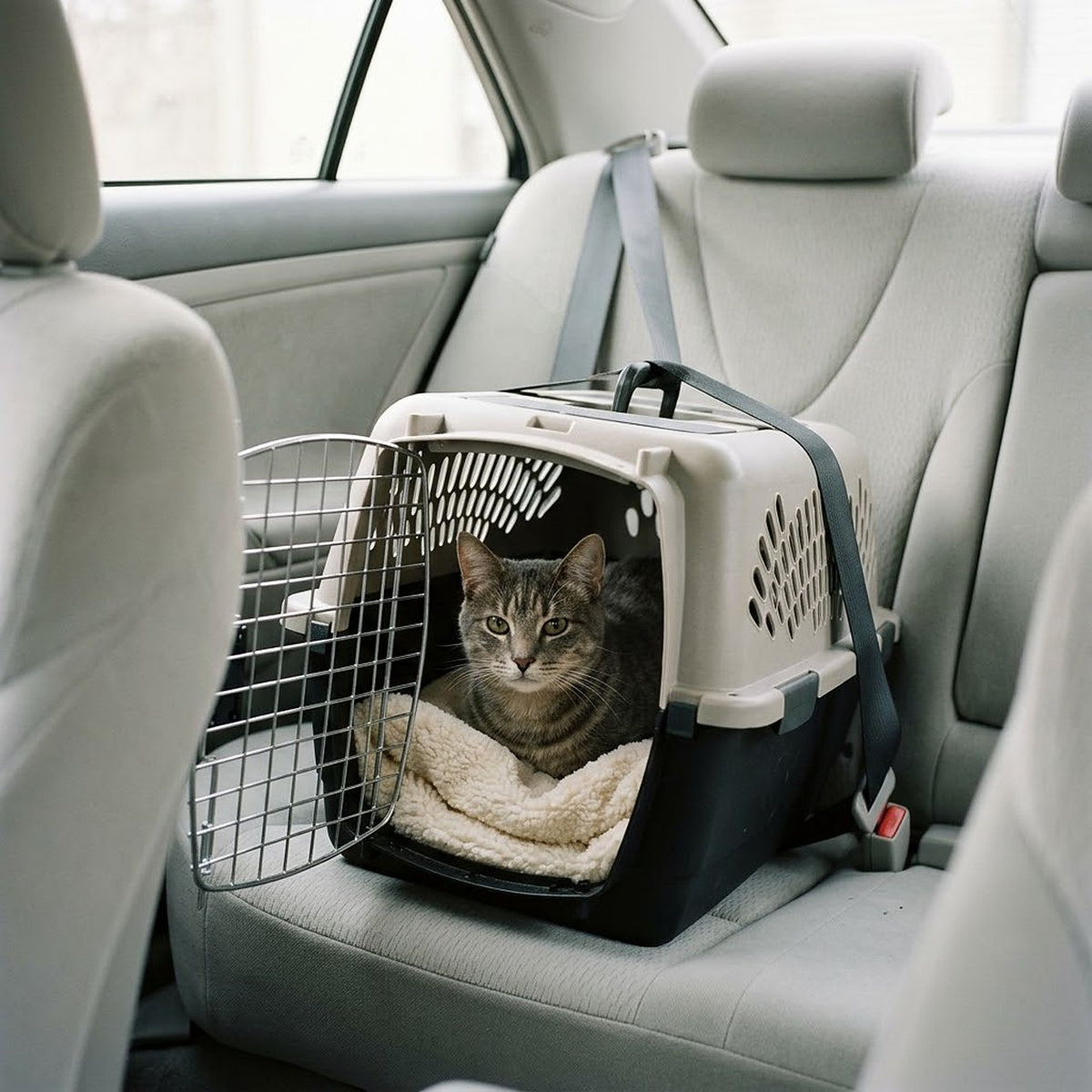
Is my cat cold? Less quickly than you, and it will tell you less clearly than a dog would. A healthy adult cat, with its winter coat, copes very well with a few hours outside at 5 °C; the same cat, wet, motionless, at 0 °C for a whole night, is in danger. And a kitten, an old arthritic cat, an ill cat or a hairless cat do not have the same margin at all. From what temperature you should worry, outdoors and indoors, the signs that do not lie, hypothermia and how to warm a cat up, what an outdoor cat really needs, the hazards specific to winter, antifreeze, salt, car bonnets, and how to give it a cosy winter without overheating it.
Cats and cold: the essentials in brief
| The threshold | below about 7 °C, staying outside for long becomes risky for a cat, according to Cats Protection; much sooner for kittens, old, ill or hairless cats; wind and damp lower the threshold |
|---|---|
| The signs | it curls up tightly, seeks warmth, cold ears, paws and tail, less active; shivering is rare and late |
| Cold to the touch | cold ears, paws and nose on a lively cat that eats: it is saving its heat, that is normal; cold to the touch and listless, pale gums, off its food: take its temperature and call the vet |
| Hypothermia | weakness, wobbly gait, slow shallow breathing, pale gums; collapse and dilated pupils: life-threatening emergency; warm it gently, never with hot water or a hairdryer |
| Outdoors | an insulated, raised, waterproof shelter with a small entrance and straw; access to the indoors; water that does not freeze; brought in at night when it freezes |
| Winter hazards | antifreeze (a few drops are enough to destroy the kidneys), road salt, still-warm car bonnets, closed sheds |
| At home | an enclosed, raised bed away from draughts; a radiator hammock or a self-heating mat; no electric heating pad without supervision |
| The fragile ones | kitten, old or arthritic cat, ill or thin cat, sphynx and short-coated breeds: indoors in cold weather, and a sweater or onesie for hairless cats |
| "It caught a cold" | sneezing, runny nose and eyes: that is cat flu, caused by viruses and not by the cold itself; vet if it stops eating, and quickly for a kitten or an old cat |
Sources: Cats Protection, International Cat Care, ASPCA, Alley Cat Allies (shelters), MSD Veterinary Manual, Santévet. Details at the end of the article.
Contents
From what temperature does a cat get cold?
The cat descends from a desert feline, and it shows: it seeks warmth well beyond what we find comfortable, the radiator, the sunbeam, the top of the internet box. Veterinary nutrition manuals put its thermal comfort zone, the one where it spends nothing to warm up or cool down, around 30 to 38 °C (National Research Council, 2006): in a house at 20 °C, a resting cat is already a little "below", and that is why it curls up against you. It compensates effortlessly thanks to its coat, especially in winter, when the undercoat thickens.
Outdoors, the clearest reference comes from Cats Protection, the largest British feline charity: "anything below about 7 °C can start to be unsafe for cats to stay outside, especially for long periods". The figure applies to a dry, healthy adult cat that has a shelter. It must be adjusted to the cat and the weather:
| Outside | Healthy adult cat, used to going out | Kitten, old, ill, thin, hairless or convalescent cat |
|---|---|---|
| Above 10 °C | nothing in particular; a dry shelter if it has no cat flap | short, supervised outings; hairless cats stay in |
| 7 to 10 °C | an insulated shelter available, brought in at night if it rains or blows | indoors, except a few minutes in the sun |
| 0 to 7 °C | shorter outings, in at night, water checked twice a day, shelter lined with straw | indoors |
| Below 0 °C | indoors at night, outside only if it can come in whenever it wants; closed sheds and garages checked | indoors, and a warm bed |
Landmarks, not thresholds: based on Cats Protection (7 °C), International Cat Care (bring cats indoors to sleep when it is very cold) and the ASPCA. A wet cat loses most of its insulation: rain at 8 °C is more dangerous than a dry frost at −2 °C.
And indoors? A home heated to 18-20 °C suits all cats; below 15 °C at night, an old cat, a kitten or a sphynx needs a bed that keeps the heat in. An unheated garage or conservatory is at the outdoor temperature, without the sun: more on that below.
How to tell my cat is cold: the signs that do not lie
A cold cat almost never shivers: shivering is a late sign, and the MSD Veterinary Manual points out that it is not a reliable sign of hypothermia. Look instead for:
- it curls up tightly, tail wrapped over its nose, paws tucked under it;
- it seeks warmth insistently: the radiator, your lap, under the duvet, the desk lamp;
- it has cold ears, cold pads and a cold tail tip, to the touch;
- it is less active, sleeps more, plays less, hesitates to go out or comes back very quickly;
- its coat is fluffed up, to trap air.
All of this is a cat that is cold and coping: offer it a warmer spot and it is sorted. Hypothermia is something else: body temperature, normally 38 to 39 °C, drops, and the cat can no longer bring it back up. The signs, according to Cats Protection and the MSD: weakness or a wobbly gait, slow, shallow breathing, a slow pulse, pale gums, confusion; then collapse, unresponsiveness and dilated pupils, which are a life-threatening emergency.

Warming up a cat that is too cold. Dry it if it is wet, wrap it in a blanket, and place lukewarm (not hot) water bottles wrapped in a cloth against it, or hold it against you. No hot water, no hairdryer, no electric heating pad, no rubbing: a hypothermic cat gets burned without feeling it, and rapid rewarming makes things worse. Then the vet, without delay, if the gait is wobbly, the breathing slow or the gums pale.
Cold ears, nose, paws: my cat is cold to the touch, is it serious?
The ears, the tips of the paws and the tail are the first parts of the body a cat "sacrifices" when it is cold: it reduces the blood flow there to keep its heat at the core, where the organs are. Cold ears on a lively cat that eats and plays therefore mean nothing more than "it is chilly": a warmer spot, and they warm up within minutes. The same goes for the nose: its temperature and moisture change through the day depending on whether the cat is sleeping, grooming or coming in from outside; a cold nose, or a dry one, says nothing about its health, despite a stubborn belief.
What should alert you is cold to the touch combined with something else: a cat that is listless, no longer eats, hides, has pale gums, breathes fast or on the contrary slowly, has vomited or has diarrhoea. There, cold is no longer the cause but the sign: an ill or dehydrated cat, a cat in shock or in advanced kidney failure no longer produces enough heat, and can be hypothermic in a living room at 21 °C. In that case, take its temperature and call the vet.
Taking a cat's temperature. With a soft-tipped rectal thermometer, lubricated, the cat wrapped in a towel and held by a second person. Normal temperature is about 38 to 39 °C; below 37.8 °C it is hypothermia, according to PetMD, and a call to the vet; above about 39.5 °C, it is a fever. Forehead or ear thermometers made for humans are not reliable on cats.
An outdoor cat in winter: shelter, water, food
A cat with access to the house through a cat flap manages its own winter: it goes out less, sleeps more, and comes in to warm up. Just check that the cat flap does not freeze and that it can still push it. For a cat that sleeps outside, a garden cat, a farm cat or a free-living cat you feed, the shelter is what makes the difference between a bearable winter and hypothermia. The charities that care for free-living cats have codified the ideal shelter:

- Small: a cat warms itself with its own body heat, and it cannot heat a large volume. For one or two cats, the inside need not exceed 60 cm long by 40 wide and 40 high.
- Insulated: double walls (thick wood, insulating foam, polystyrene between two boards), not a single plank.
- Raised by 10 to 15 cm, on feet or blocks: frozen ground draws heat away, and the shelter stays dry in rain or melting snow.
- Waterproof, a sloping roof, and a small entrance of about 15 cm, facing away from the prevailing wind and, if possible, protected by a soft flap; a second exit reassures some cats but cools the shelter.
- Straw inside, not blankets, towels or hay: fabrics absorb moisture and freeze, hay goes mouldy, straw stays dry and insulates. A cushion is fine in a well-sealed shelter, provided you check it and change it as soon as it is damp.
- Out of the wind, against a wall, under an overhang, in an open shed, never in the middle of the lawn.
Water freezes: a thick bowl, sheltered, filled with lukewarm water morning and evening, or an insulated bowl; never snow as the only source. Food: an outdoor cat burns more calories in winter, so increase its ration a little and serve at fixed times, so that it does not wait in the cold; kibble withstands frost better than wet food. And in hard frost, International Cat Care is clear: cats come in to sleep indoors, in a garage, a utility room, a closed room with litter and water.
Does a cat get cold in a garage, a conservatory, a shed?
It is one of the most asked questions, and the answer fits in one sentence: an unheated room is at the outdoor temperature, minus the wind and rain, and without the sun. A garage at 4 °C at night is a cat sleeping outside at 4 °C, under cover. That is not a deal-breaker, provided you set it up:
- The garage: an insulated, enclosed bed, a cave, an outdoor shelter placed inside, or a box lined with polystyrene and filled with straw or a thick blanket changed as soon as it is damp, up high, away from the door and from the concrete floor that draws heat away; water, a litter tray; no antifreeze, screenwash or chemical container within reach; and an exit the cat controls itself, a cat flap or a door left ajar, so that it can get back to the house if it gets too cold.
- The conservatory: overheated in the sun, freezing at night, sometimes colder than outside in the early morning because of the glass. A cat can spend winter days there, not the nights, unless the conservatory is insulated and heated.
- The shed, the garden hut: fine if it is waterproof and the cat can get out at any time; locked up for the winter, it becomes a trap. An insulated shelter placed inside makes an excellent dormitory.
- The balcony: an indoor cat can get some air there for a few minutes in cold weather, with a corner out of the wind and a safety net; in frost or rain, the window stays ajar so that it comes in whenever it wants.
For an old cat, a kitten or a thin cat, none of these rooms replaces a heated room.
Antifreeze, salt, car bonnets: the winter hazards
Antifreeze is the poison of winter. It contains ethylene glycol, sweet-tasting, and "even just a few licks of antifreeze can cause serious harm, such as kidney failure", Cats Protection writes. The first signs, one to twelve hours later: the cat staggers as if drunk, vomits, drinks and urinates a lot; then comes the kidney damage, often irreversible. A cat that may have licked a puddle under a car or a spilled container goes to the vet immediately, before the signs: treatment only works in the very first hours. Put containers away, wipe up spills, and know that "winter" screenwash contains it too.
Road salt and grit irritate the pads, and the cat licks them while grooming: when it comes in, a wipe with a damp glove over paws and belly. Bonnets: a still-warm engine is the best radiator in the neighbourhood, and cats slip underneath; before starting the car in cold weather, tap the bonnet and sound the horn once. Sheds, garages and cellars closed up for the winter trap cats every year that went in to get warm: check before locking. Frostbite affects the ear tips, the tail tip and the toes: pale, cold skin, then red and swollen, sometimes black; warm gently and see the vet. Finally, in winter it is dark at 5 pm: a reflective safety-buckle collar makes a cat visible to cars.
A cosy winter at home, without overheating it
Most indoor cats need nothing more in winter than a warm place to sleep. What they like:
- An enclosed or enveloping bed, cave, donut, sleeping bag, which keeps its body heat in, placed up high and away from draughts: not on the floor by a door or window, rather on a piece of furniture, a shelf or in a sunbeam.
- The radiator: a radiator hammock gives it the spot it demands anyway, with no risk of burns as long as the radiator is a water radiator or the temperature stays reasonable; not on a scorching electric convector or in front of a stove without a fireguard.
- A self-heating mat, which reflects body heat without electricity: perfect for an old cat, a kitten or a convalescent cat, and safe. Electric heating pads, on the other hand, are not left on unsupervised or under a cat that cannot move: contact burns are classic in old cats.
- Fleece blankets in its favourite spots, washable, changed when damp.
And the indoor hazards: the fireplace and stove (fireguard), candles, the open oven, and the tumble dryer: a cat happily falls asleep in warm laundry, so check the drum before starting it. A cat that pants, stretches out full length on the tiles or seeks the window is too hot: it does not need a coat, it needs a cool corner.

The cat in winter: what changes in its behaviour
A cat that changes its rhythm in November is not ill, it is adapting:
- It sleeps more, and closer to heat sources: short days and cold stretch already long naps. As long as it eats, plays and grooms, all is well; our guide on the cat that sleeps a lot says when to worry.
- It goes out less, and for shorter spells, especially in rain: an outdoor cat becomes half an indoor cat, and therefore needs a clean litter tray inside.
- It eats a little more if it lives outside, to keep warm; an indoor cat, on the other hand, spends less and readily puts on weight in winter: keep the ration and increase play, our guide to the bored cat gives ideas.
- Its coat changes: the winter undercoat grows in autumn and falls out in spring; an indoor cat, helped by heating and artificial light, sheds a little all year round. One more brushing a week limits hairballs.
- It is more cuddly: you are the radiator. Enjoy it.
Kitten, old, ill, hairless cat: the ones that really get cold
The kitten under four weeks does not regulate its temperature: it depends on its mother, a warm nest, a wrapped lukewarm bottle. A weaned kitten gets cold much faster than an adult, and it does not go out in winter before its vaccinations anyway.
The old cat has less fat, less muscle, and often arthritis: "cats with arthritis, particularly elderly cats, can suffer in cold weather", notes Cats Protection, which advises padded beds, steps to climb up, and low-sided litter trays. The cold wakes up the pain: an old cat that no longer jumps onto the sofa in January is not "tired", it hurts. Our guide to the senior cat details what to have checked by the vet.
The ill or thin cat, with kidney disease, hyperthyroidism, diabetes, or convalescing, does not produce enough heat: indoors, a warm bed, and an eye on its appetite.
The sphynx and very short-coated cats (devon rex, cornish rex, fine orientals) have no insulation: they are the only cats for whom a sweater or a fleece onesie makes sense, at home when the heating is low, and never outside in winter.

"My cat caught a cold": sneezing, runny nose, cat flu
A cat that sneezes, has a runny nose and eyes and turns up its nose at its bowl after a few cold days has not "caught a cold" in the sense we mean: it is not the cold that made it ill. This "cat cold", cat flu, is a viral infection, "mainly caused by one of two viruses; feline herpes virus and feline calicivirus", Cats Protection points out, and "highly contagious" between cats, through sneezing and contact. The cold still plays a part: the season gathers cats indoors and, above all, wakes the virus up in carrier cats, since "once cats have recovered from cat flu, it's possible for some cats to continue to harbour the infection and come down with cat flu again, particularly during times of stress or other illness".
The signs: bouts of sneezing, discharge from the nose and eyes, clear then thick, red or half-closed eyes, fever, listlessness, sometimes mouth ulcers (calicivirus) that make the cat drool and refuse food. In a fit, vaccinated adult, it clears in one to two weeks, with nose and eyes cleaned with saline and warmed wet food to wake up the sense of smell. See the vet without delay if the cat has not eaten for 24 hours, breathes with its mouth open, has a closed or painful eye, and if it is a kitten, an old cat or an already ill cat: cat flu quickly puts them in danger. Vaccination does not always prevent it, but it avoids the severe forms: "the easiest way to stop your cat from getting severe cat flu is by getting them vaccinated", and the booster is often given before winter.
Cats and cold: our selection
For outdoors as for indoors: what it takes to make a warm spot it will choose by itself.
 Insulated, raised outdoor shelterView product
 Radiator hammockView product
 Self-heating mat, no electricityView product
 Velvet cave bed with earsView product
 Plush sleeping bagView product
 Felt donut tunnel bedView product
 Fleece blankets, set of 3View product
 Fleece onesie for hairless catsView product
 Soft-tip digital thermometerView product
Frequently asked questions: cats and cold
From what temperature does a cat get cold?
Outdoors, below about 7 °C for a healthy adult cat that stays still for long, according to Cats Protection; much sooner if it is wet, if it is windy, or for a kitten, an old, ill or hairless cat.
How can I tell my cat is cold?
It curls up tightly, seeks warmth, has cold ears, pads and tail, moves less and fluffs up its coat. Shivering is rare and late: a cat that shivers is already very cold.
Can a cat sleep outside in winter?
A healthy adult, yes, if it has an insulated, raised and waterproof shelter lined with straw, unfrozen water and, ideally, access to the indoors. When it freezes, the charities recommend bringing it in for the night.
Does a cat get cold in a garage?
An unheated garage is at the outdoor temperature, without the sun: yes, it can get cold there. It works for the night if it finds an insulated bed there, up high, away from the door, with water and litter, and no antifreeze container within reach.
Do cats get cold indoors?
Rarely: between 18 and 20 °C, all cats are fine. Below 15 °C at night, an old cat, a kitten or a sphynx needs an enclosed bed that keeps the heat in, placed up high and away from draughts.
What is the ideal temperature for a cat?
Its thermal comfort zone lies around 30 to 38 °C, which explains the radiator and the sunbeam; in a house at 20 °C it compensates easily thanks to its coat. What it needs is the choice: a warm spot and a cool spot.
My cat is shivering: is it cold?
Perhaps, but shivering comes late in cats: if it shivers, warm it in a blanket and check its gums and gait. A cat that shivers while warm may have a fever, pain, or fear: vet if it lasts.
What are the signs of hypothermia in cats?
Weakness or a wobbly gait, slow shallow breathing, slow pulse, pale gums, confusion; then collapse, unresponsiveness and dilated pupils. It is an emergency: gentle rewarming and the vet immediately.
How do I warm up a cold cat?
Dry it, wrap it in a blanket, place wrapped lukewarm water bottles against it or hold it against you. Never hot water, a hairdryer, an electric heating pad or rubbing. If it stays weak, the vet.
Can a cat get frostbite?
Yes, on the ear tips, the tail and the toes: pale, cold skin, then red, swollen, sometimes black. Warm gently without rubbing and see the vet: the affected tissue takes several days to show its state.
Why is antifreeze so dangerous for cats?
It contains ethylene glycol, sweet-tasting, and a few licks are enough to destroy the kidneys. A cat that staggers, vomits or drinks a lot after going out, or that may have licked a puddle, goes to the vet immediately: treatment only works in the first hours.
Is road salt dangerous for my cat?
It irritates the pads and the cat swallows it while grooming, which can cause vomiting and diarrhoea. Wipe its paws and belly with a damp glove when it comes in.
Why tap on the car bonnet in winter?
Because a still-warm engine attracts cats, which slip underneath or into the engine bay. A tap on the bonnet and a honk before starting give them time to get out.
Should I feed my cat more in winter?
An outdoor cat spends more to keep warm: a little more kibble, at fixed times. An indoor cat that goes out less tends to put on weight instead: change nothing, or play more.
Should I put a sweater on my cat?
Only on a hairless or very short-coated cat, at home when the heating is low. A cat with a normal coat does not need one and tolerates it badly: a warm bed does the job better.
Does a kitten get colder than an adult cat?
Yes: before four weeks it does not regulate its temperature, and for several months it cools down far faster than an adult. Warm nest, wrapped lukewarm bottle, and no outings in winter.
What position does a cold cat take?
Curled up tightly, tail wrapped over its nose and paws tucked under it, often up high or against a heat source. A hot cat does the opposite: stretched out full length on a cool surface.
My cat's ears are cold: is it ill?
No, if it is lively and eating: it reduces blood flow to its extremities to keep its heat at the core. Cold ears with listlessness, pale gums or loss of appetite: take its temperature and call the vet.
Can a cat die of cold?
Yes, of hypothermia, when its temperature drops below 37.8 °C and keeps falling: a wet, motionless cat, shut outside, ill, a kitten or a very old cat. A healthy adult with a shelter, food and water almost always survives.
Do cats get cold outside at night?
Night is the coldest time, especially between 4 and 7 am, with no sun to warm up. Below 7 °C, a cat with neither an insulated shelter nor access to the indoors is cold; when it freezes, bring it in.
Do cats need a blanket?
A warm spot more than a blanket: a fleece in its basket pleases it, but it is the enclosed bed, up high and away from draughts, that keeps the heat in. Never cover a cat by force.
Can a cat live outside all year round?
A healthy adult used to it, yes, with an insulated shelter, unfrozen water, food, and access to the indoors in hard frost. Not a kitten, an old, ill or hairless cat.
My cat caught a cold, what should I do?
Sneezing and a runny nose are cat flu, a viral infection, not a chill. Keep it warm, clean nose and eyes with saline, warm its wet food; vet if it has not eaten for 24 hours, breathes with its mouth open, or if it is a kitten or an old cat.
What temperature can a cat withstand in winter?
A healthy adult, dry and sheltered, copes with a few hours around 0 °C; below 7 °C over time, the risk rises, according to Cats Protection, and frost calls for an insulated shelter or the house. Wet or in the wind, it loses most of its protection.
Sources
- Cats Protection, "Cats and cold weather"
- International Cat Care, "Hazardous weather and your cat"
- ASPCA, "Cold weather safety tips"
- Alley Cat Allies, "Outdoor cat shelter options": dimensions, insulation, straw
- MSD Veterinary Manual, "What to do in a dog or cat emergency", hypothermia
- National Research Council, "Nutrient Requirements of Dogs and Cats", 2006: the cat's thermoneutral zone
- Santévet, "Mon chat peut-il attraper froid ?", updated May 2026 (in French)
- PetMD, "Hypothermia in Cats": normal temperature, hypothermia threshold
- Cats Protection, "What is cat flu": viruses involved, carriers, vaccination
Article updated on 22 October 2026. The photos in this article were generated by AI. Read also: cat age in human years, how much do cats sleep and lost cat: what to do.